

Jaipur is a flat city with a habit of hiding its best angle. Down at street level you get the noise, the colour, the happy tangle of the bazaars. Climb a little higher, though. The whole thing rearranges itself into something you will remember for years. A pink grid runs clean to the hills. Domes and temple spires poke through the rooftops. The old forts stand guard along the ridge like sentries who never stood down. The single most common question we hear from guests planning an evening is where to find the best sunset point in Jaipur. In truth, the city hands you several, from a hilltop fort to a forgotten tower in the old town, each one showing a different version of the place. Here is where to look up.
The Sunset Point in Jaipur Everyone Means
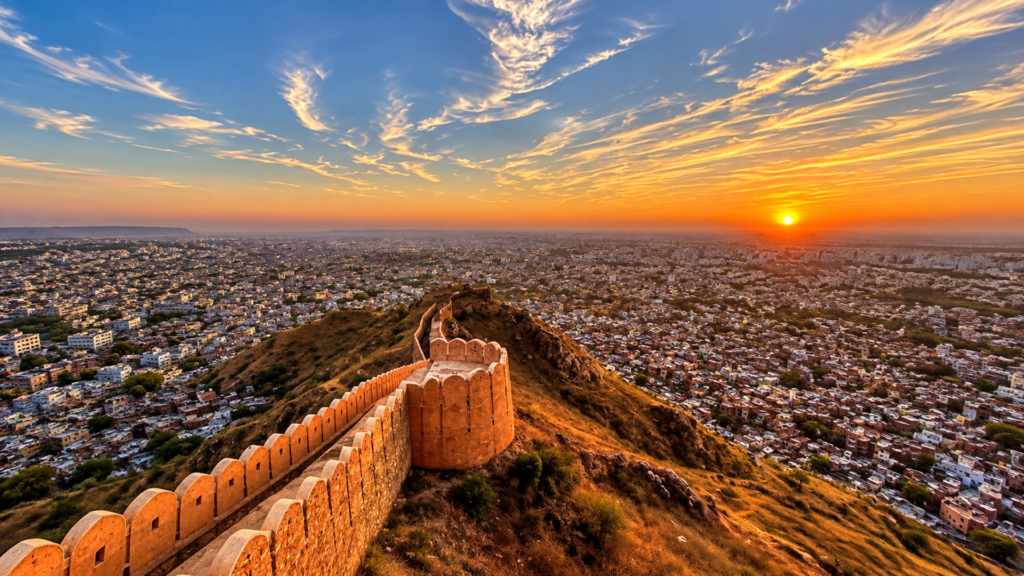
Say the word sunset to any local. One name comes straight back. Nahargarh Fort sits on a ridge of the Aravalli hills to the north, roughly seven hundred feet above the rooftops. It has held the title of the classic sunset point in Jaipur for as long as anyone can remember. Built in 1734 by Sawai Jai Singh the Second, the same king who drew up the city below, it began life as a defensive lookout, one corner of a triangle of forts that could signal one another across the valley. These days people make the climb for the view, not the walls. As the light drops, the whole Pink City shifts from terracotta to gold to a slow scatter of lights, the forts of Amer and Jaigarh turning to dark shapes on the far hills.
Many stay on past dark, when the fort is floodlit, and the city becomes a carpet of lights below. Two honest warnings from experience. The road up is steep and twisting, the traffic heavier than any map admits, with everyone in town sharing the same idea at the same hour. Reckon on thirty to forty minutes up from the old city, longer in the evening crush. Go a good while before the sun drops. The wait becomes part of the pleasure.
A Tower in the Middle of It All
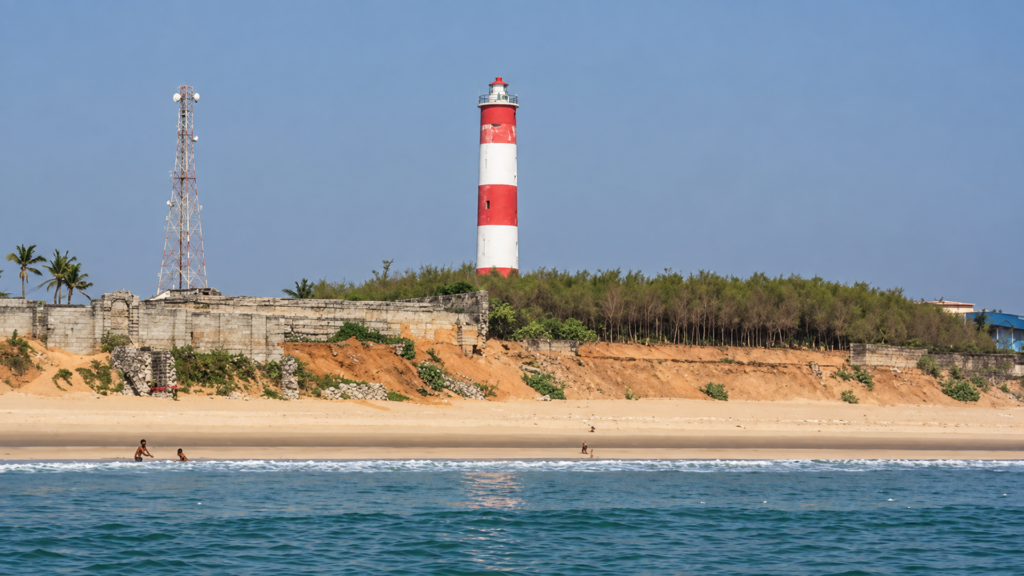
Not every high place needs a car or a hill road. Tucked into the old town, a short step from the City Palace, stands the Isar Lat, also known as the Sargasuli, a slender victory tower raised in 1749 that most visitors walk straight past without a glance. It was built to mark a battle won, styled loosely after the great Qutub Minar in Delhi, climbing seven storeys over the surrounding market. The entry costs only a few rupees; the climb takes only a few minutes. Wind your way up its narrow internal ramp to a full 360-degree view of Jaipur that almost nobody around you has thought to seek out. The old city opens beneath you exactly as it was planned, a tidy grid of pink blocks, the bazaars humming, kites and temple flags snapping in the wind, Nahargarh floating on the ridge in the distance.
It is loveliest in the late afternoon, when a low sun rakes gold across the rooftops. Guests who look for hotels near City Palace can reach the tower on foot in minutes, which is rather the whole argument for staying inside the walls in the first place.
The Forts on the Skyline
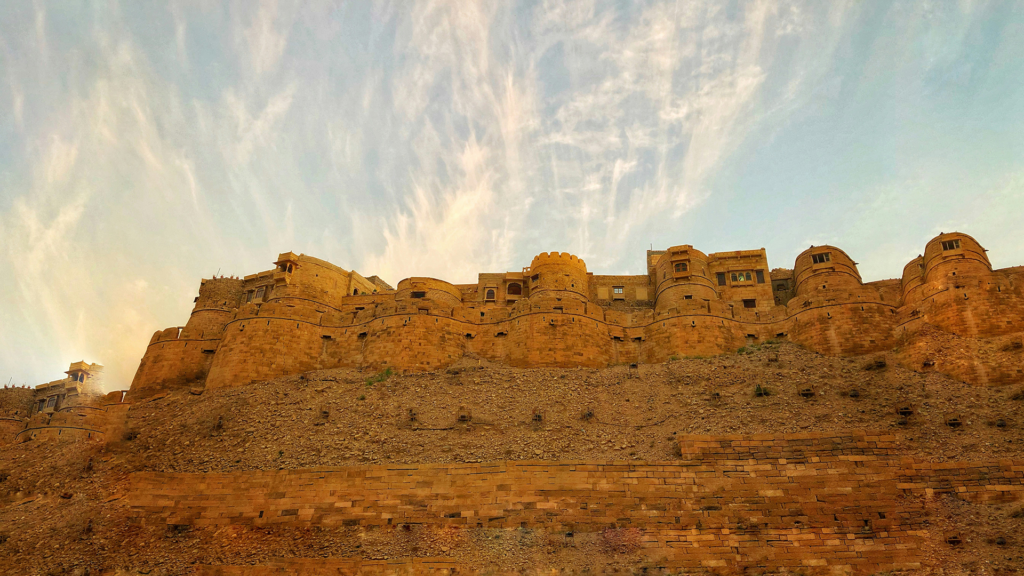
If you have longer than an evening, the hill forts turn a single viewpoint into a proper half-day out. Amer Fort, the old royal capital, rises above a still lake a short drive to the north. Its ramparts open long views back down the valley, its mirrored halls worth the trip on their own. Higher up the same hillside sits Jaigarh, the muscular military fort, which guards one of the largest cannons on wheels ever cast, with a clean sweep of dry hills in every direction.
Taken together, Nahargarh, Amer and Jaigarh form the defensive ring the city was born with, each one raised within sight of the next. Fort-hopping across the three is one of the more rewarding things to do in Jaipur for anyone who likes a view with a little history attached. The higher you climb, the smaller the modern sprawl below seems to drift.
From the Old City’s Own Roofs
There is a gentler kind of height that asks for no ticket, no taxi at all. The old walled city is a place of flat terraces, where life has always spilled upward, to dry red chillies in the sun, to fly kites by the hundred each January, to catch a breeze the lanes never see. A morning cup of tea on a rooftop, with the first light warming the pink walls, the city stirring awake below, is one of the simplest, finest things to do in Jaipur, one that no guidebook can really hand you.
This is the everyday view of Jaipur that residents have kept to themselves across the centuries, the one you tend to find only by staying somewhere with a terrace of its own, not by queuing for a monument.
When to Go Up
Timing changes everything up high. The hour before sunset is the prize, when the low sun deepens the terracotta, the whole town glowing before the lights take over. Early morning runs it close, cooler, calmer, the empty streets washed in soft, clean light. Give the harsh middle of the day a miss, when the flat glare drains the colour, the heat doing you no favours. The cooler months from October to March are kindest for a climb. If you are here in mid-January, the skies above every rooftop fill with kites for the festival of Makar Sankranti, a sight in itself. Bring a light layer for the evenings, since the desert cools fast once the sun is gone.
Watch It From Our Roof
That, as it happens, is where we come in. We are a family-run haveli inside the old city with a rooftop of our own. Guests who search for hotels near City Palace are usually after exactly this: a genuine old home within the walls, a short walk from the gates and the markets, with a calm corner up top to end the day. Come take the pink from above with a cup of tea in hand, watch the swifts wheel over the terraces, let the forts light up along the hills while the lanes below settle for the night. Write to us for dates. We will save you the best seat on the roof.
Frequently Asked Questions
Is Nahargarh really the best sunset point in Jaipur?
It is the most famous, and it earns it, with a full sweep of the city from the hills. But it is not the only sunset point in Jaipur. A high terrace in the old town, or the Isar Lat tower, gives you the same golden light with a fraction of the crowd.
Can you get a good view of Jaipur without trekking up to a fort?
Easily. The Isar Lat tower near the City Palace hands you a 360-degree view of Jaipur from the middle of the old town, and any high terrace does much the same. You need neither a car nor a hill for the best of it.
Is sunrise or sunset better from a rooftop?
Both win, for different reasons. Sunset brings the crowds and the drama, the pink deepening to gold. Sunrise brings soft light, empty lanes and calm, with far fewer people about. For photographs without the queues, go up early.
Do you have to pay to see Jaipur from above?
Usually very little. The forts and the Isar Lat tower charge a small entry fee, while a rooftop where you are staying costs nothing at all. Seeing the city from height is one of the cheapest things to do in Jaipur.
Where should you stay for the best rooftop views?
Inside the old walls, close to the sights. Travellers comparing hotels near City Palace tend to land in the right spot, a short walk from the gates, with the pink rooftops and the distant forts on show from the terrace.
