

From the composed preparation of Bandhani knots to the steady placement of carved blocks on cotton, both crafts sit at the heart of Rajasthan’s textile heritage. Each piece made this way carries the touch of Rajasthani textiles, where skill and knowledge guide every stage of the work.
Rajasthani Textiles: A Living Heritage
The Land of Kings has long been home to remarkable artisans whose work still reflects the state’s cultural identity. Among these traditions, Bandhani art and block printing in Jaipur remain two of the most treasured expressions of Rajasthani craftsmanship. Two traditions dominate: Bandhani, tied and dyed, and block printing, carved and stamped. Together, they account for most of the Rajasthani textiles Jaipur is known for.
History of Bandhani Art
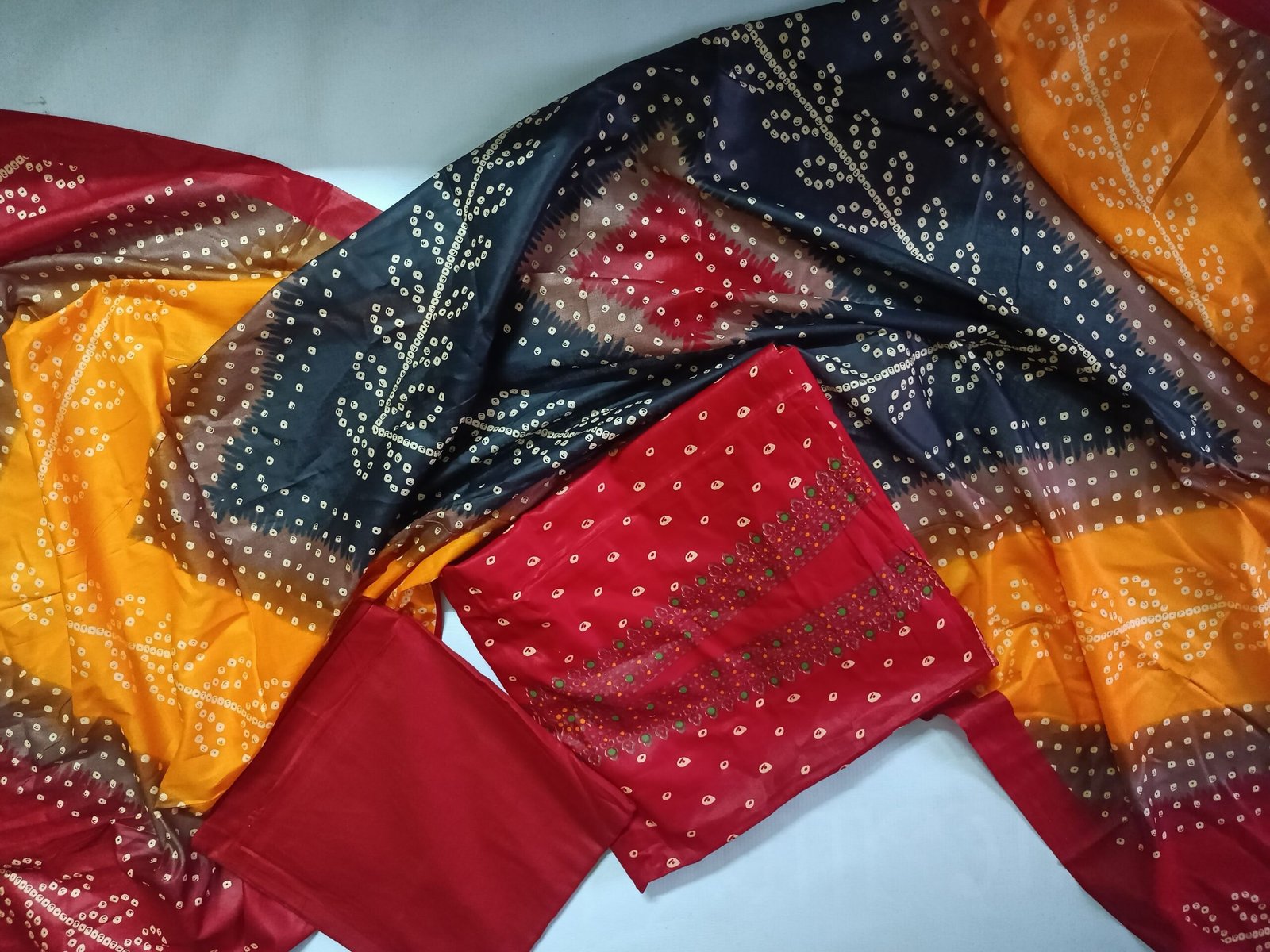
Bandhani is one of India’s oldest textile practices, with roots in ancient trade and community life. The word Bandhani comes from a term meaning to tie, describing the detailed process in which artisans secure small points of fabric with thread before dyeing. These tied portions retain their base colour, forming patterns once the fabric is dyed and opened.
In Rajasthan, this art has long been linked with celebration. Women wear Bandhani sarees and odhnis during important occasions, as the colours and motifs are thought to bring good fortune. The craft began in the Bhil community and later became part of noble customs, with each design carrying its own meaning.
How Bandhani Is Made, Knot by Knot
The tying is done by women working from memory and a stencilled guide, using a pointed metal fingernail guard to lift a tiny peak of cloth before binding it with thread. Fabric is folded into four or eight layers first, so a single knot produces four or eight dots, and a design of forty thousand points may need only a fraction of that in actual ties.
Patterns are named for their dot groupings. Ekdali is a single dot, trikunti a cluster of three, chaubundi four, and the dense chandrokhani and shikari forms build these into figures and landscapes.
Leheriya belongs to the same resist family but works differently, with the cloth rolled diagonally and bound at intervals to produce waves rather than dots. Jaipur, Sikar, Jodhpur and Bhilwara remain the main centres, and the finest work still takes weeks per piece.
The work requires patience and focus. Artisans tie thousands of tiny sections by hand, dip the cloth in natural dyes, and then open each knot to show the final arrangement of motifs. The slight variations created by hand ensure that each textile is distinct. This individuality is what keeps Bandhani central to Rajasthan’s textile tradition, and it is why no two pieces are ever quite alike.
The Craft of Block Printing in Jaipur
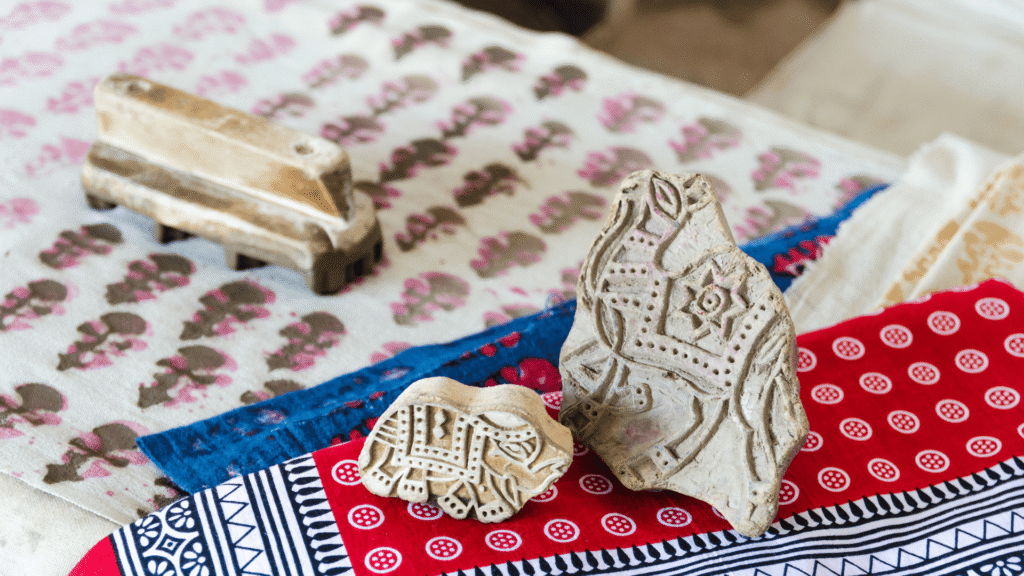
Block printing has flourished in Jaipur for centuries. This craft uses carved wooden blocks coated with dye, pressed onto fabric to create repeating patterns. Each block is carved by hand, and the precision needed to keep designs aligned shows the depth of skill Jaipur’s artisans possess.
The city is primarily known for the Sanganeri and Bagru styles. These designs draw inspiration from flowers, architecture and geometric forms, each carrying the mark of Rajasthani craftsmanship. Artisans prepare dyes using natural pigments, creating textiles with a gentle, long-lasting finish.
The process includes washing the cloth, preparing colour baths, drying the fabric in open courtyards and finally printing the pattern. The slight differences created by hand give each textile its own character. This long-standing tradition has made Jaipur one of the most respected centres of Rajasthani textiles.
Sanganeri and Bagru: Two Villages, Two Traditions
Jaipur’s printing splits into two traditions practised twenty kilometres apart. Sanganer prints fine floral repeats on a bleached white ground. Bagru dyes the cloth first and creates the pattern with dabu, a mud resist, using earth pigments that run darker and more geometric. Both are printed by the Chhipa community, and both sit at the centre of the traditional textiles of Rajasthan. We have covered where to buy from each in detail separately.
Where to See and Buy Rajasthani Textiles in Jaipur
Sanganer sits about fifteen kilometres south of Jaipur, and Bagru roughly thirty kilometres west; both take walk-in visitors at the smaller units, though the larger karkhanas prefer a call ahead. Watching a printer place a block by eye, judging the join by a corner mark rather than a guide, explains more in five minutes than any amount of reading.
In Amer, the Anokhi Museum of Hand Printing occupies a restored haveli and has carvers and printers working on site. It closes on Mondays and during the hottest weeks of summer.
In the city itself, Bapu Bazaar carries the widest range of printed cottons, and Kishanpole and Chandpole are better for smaller workshops. Government emporia are fixed-price and reliable if you would rather not negotiate. If you want to buy Rajasthani textiles close to the source, the villages are worth the drive.
How to Tell Hand Block Print from Screen Print
This is the single most useful skill for anyone buying handmade Rajasthani textiles, and it takes about ten seconds once you know what to look for.
Turn the cloth over. On a hand block print, the dye has penetrated the weave, and the reverse shows the pattern clearly, though softer. On a screen print, the colour sits on the surface, and the back is noticeably paler.
Look next at where one block impression meets the next. A hand-printed repeat will show slight overlaps or hairline gaps at the joins, because each placement was judged by eye. Machine printing has no joins.
Dabu work from Bagru has a faint texture where the mud resist sat. Natural dyes smell of the dye bath rather than chemicals, and colours shift very slightly along the length of a cloth. Perfect uniformity is the telltale sign that something wasn’t made by hand.
Caring for Naturally Dyed Cloth
Natural dyes behave differently from synthetic ones and require a little care in the first few washes.
Wash the first time alone, in cold water, with a spoonful of salt or a splash of vinegar to help set the colour. Some bleeding is normal and not a sign of a defect. Avoid strong detergents and never bleach, as alkaline soaps quickly dull vegetable dyes.
Dry in shade rather than direct sun, which fades madder and indigo faster than anything else. Iron on the reverse while slightly damp. Stored well and washed gently, block-printed cotton softens and improves for years rather than wearing out.
Seeing Rajasthani Textiles at Dera Mandawa
At Dera Mandawa, our heritage haveli in Jaipur, we enjoy sharing this world of artistry with our guests. Our family has long valued the dedication of local craftsmen, and we welcome guests to learn about these traditions through conversations, demonstrations and planned visits in the old city. Every stay becomes an introduction to the depth and character of Rajasthani craftsmanship, allowing guests to learn the art of textiles as expressions of heritage and creativity.
Frequently Asked Questions
What are the traditional textiles of Rajasthan known for?
The traditional textiles of Rajasthan are known for detailed patterns, natural dyes and techniques that have been preserved through generations.
What makes Bandhani an important part of Rajasthani textiles?
Bandhani holds a special place in the Rajasthani textiles because every motif is tied by hand, giving each piece a unique character shaped by skilled artisans.
Why is block printing in Jaipur famous?
Block printing in Jaipur is admired for its carved wooden blocks, natural pigments and designs inspired by nature and architecture.
What is dabu printing?
Dabu is a mud resist. A paste of clay, gum and lime is stamped onto the cloth before dyeing, so those areas stay pale while the rest takes the colour. It is what makes Bagru work look darker and more geometric than Sanganeri, and it leaves a faint texture you can feel with a thumb.
Is Leheriya the same as Bandhani?
Same family, different method. Both resist the dye with thread, but Bandhani ties individual points to make dots, while Leheriya rolls the cloth diagonally and binds it at intervals to make diagonal stripes. Leheriya is worn most in the monsoon months and at Teej.
How do I spot a printed imitation of Bandhani?
Open the cloth and look at the reverse. Real Bandhani shows the dots on both sides because the dye went through, and the fabric keeps a slight crinkle from the tying that never fully presses out. A printed copy is flat, identical dot to dot, and pale on the back.
Do the Sanganer and Bagru workshops take visitors without an appointment?
The smaller units generally do. The larger karkhanas prefer a call ahead, and both places are quieter in the morning when printing is actually happening. Sunday is unreliable, and the Anokhi Museum in Amer closes Mondays.
How does Rajasthani craftsmanship influence textile traditions?
Rajasthani craftsmanship shapes textiles through patient work, detailed methods and an understanding of colour and form that has grown over centuries.
Are the traditional textiles of Rajasthan made using natural dyes?
Yes, many textiles are created with natural dyes, which give them gentle tones and help preserve long-standing methods within the traditional textiles of Rajasthan.
What makes traditional textiles of Rajasthan distinct from machine-made fabrics?
Traditional Rajasthani textiles carry slight variations created by the artisan’s hand, giving each piece its own individuality and sense of heritage.
How much do Rajasthani textiles cost?
Prices vary enormously with technique and time. A simple Sanganeri printed cotton stole is inexpensive, while a finely tied Bandhani odhni with tens of thousands of knots represents weeks of work and is priced accordingly. Buying at Sanganer or Bagru rather than in the city usually reflects the maker’s price more closely.
Is it safe to ship textiles home?
Yes, and most established shops arrange courier or freight as a matter of routine. Get the shipping quoted in writing before paying, and keep the invoice for customs.
Where can visitors see Rajasthani craftsmanship in Jaipur?
Visitors can see Rajasthani craftsmanship in workshops, markets and heritage spaces across the city, where artisans continue to practise these age-old techniques.
Can travellers learn about the traditional textiles of Rajasthan during their stay?
Yes, many studios and heritage homes in Jaipur provide day tours to learn about the traditional textiles of Rajasthan, from Bandhani to block printing and other local forms.
