

When the first monsoon clouds gather over Jaipur, the wardrobe of the city changes colour. Out come the lehariya, the rippling tie-dyed sarees, turbans and scarves whose diagonal waves seem to carry the rains themselves. Among all the Rajasthani traditions our guests ask us about during the monsoon, Lehariya in Rajasthan is one that belongs completely to the season. It is the cloth of the desert rains, and to understand it is to understand a little of how Rajasthan feels about water.
The name says most of it. Lehariya comes from lahara, the old word for wave, and the pattern is exactly that, a run of diagonal, wave-like stripes rippling across the fabric in bright colour. The waves stand for two things at once: the sheets of rain that sweep across the desert in July and August, and the ripples the wind leaves on the desert sand. In a land where water has always been the most precious thing of all, a cloth patterned with waves is a small act of hope.
Lehariya, the most seasonal of Rajasthani traditions
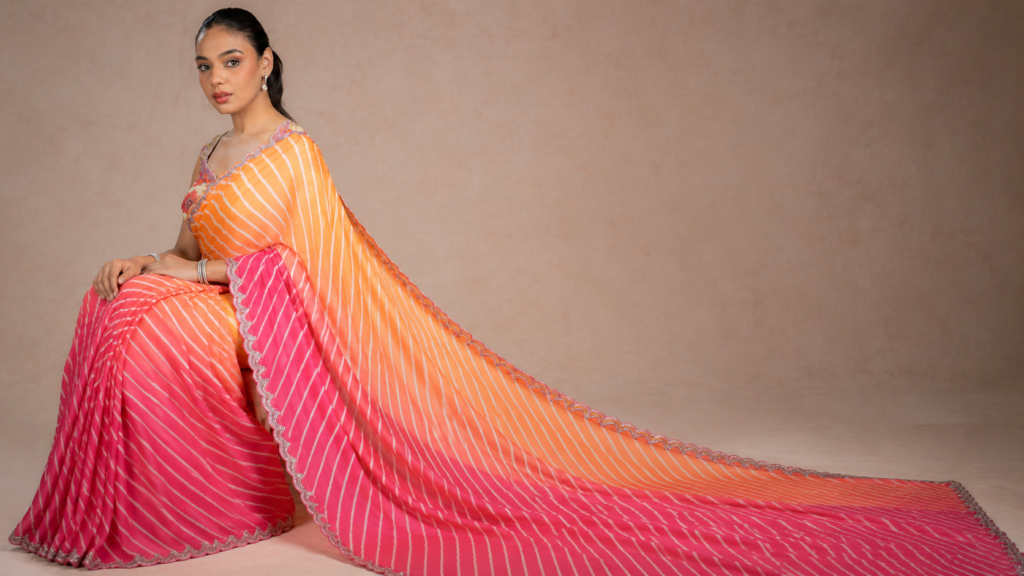
Rajasthan has a long history of resist-dyed textiles, and lehariya sits among the most loved of these Rajasthani traditions. The craft is worked above all in Jaipur and Jodhpur, the two great centres, along with Udaipur and Nathdwara, by hereditary dyeing families known as the rangrez, some of whom trace the skill back many generations. So respected is that skill that a master dyer from Jodhpur was awarded the Padma Shri, one of India’s highest civilian honours, for his command of it.
Its origins are old. Precise dates are not recorded, but miniature paintings from the seventeenth century already show Rajasthani noblemen wearing turbans patterned in these waves. For a long time it was chiefly a man’s cloth, worn as the safa, or turban, and as everyday attire for Marwari merchants and Rajput clans through the nineteenth and early twentieth centuries. The royal houses each kept their own signature palettes, and deep blue was reserved for those of the ruling class. In time, the pattern moved into women’s clothing too, into the odhni veil, the ghagra and the saree, where it lives most happily today.
How the waves are made
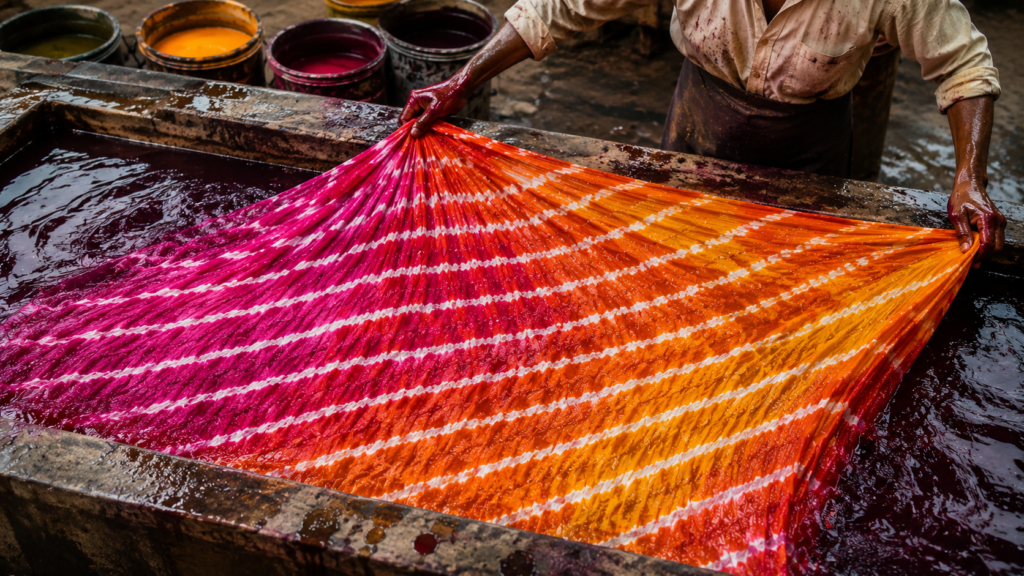
The magic of lehariya is that those flowing lines are made entirely by hand, with no printing at all. A length of fine cloth, thin cotton or silk, is rolled tightly on the diagonal from one corner to the other until it becomes a long, narrow rope. The dyer then binds it at intervals with thread. When the cloth goes into the dye, the bound sections resist the colour while the open ones drink it in, and unrolling the fabric gives that unmistakable diagonal wave. For several colours, the dyer opens some ties and adds new ones between dye baths, building the pattern up one shade at a time. The most prized cloths carry five colours, panchranga, or seven, satranga.
A close relative called mothra takes the idea a step further, tying the cloth twice in opposite directions to make a fine lattice of tiny checks in place of stripes. Where its cousin bandhani builds its pattern from small tied dots, lehariya wraps the whole cloth to draw its long lines. You can spot a genuine handmade piece easily, since it is usually sold with many of its resist ties still knotted in place, a small portion unrolled to show the pattern beneath, proof that no machine was anywhere near it.
The fabric of Teej and Gangaur
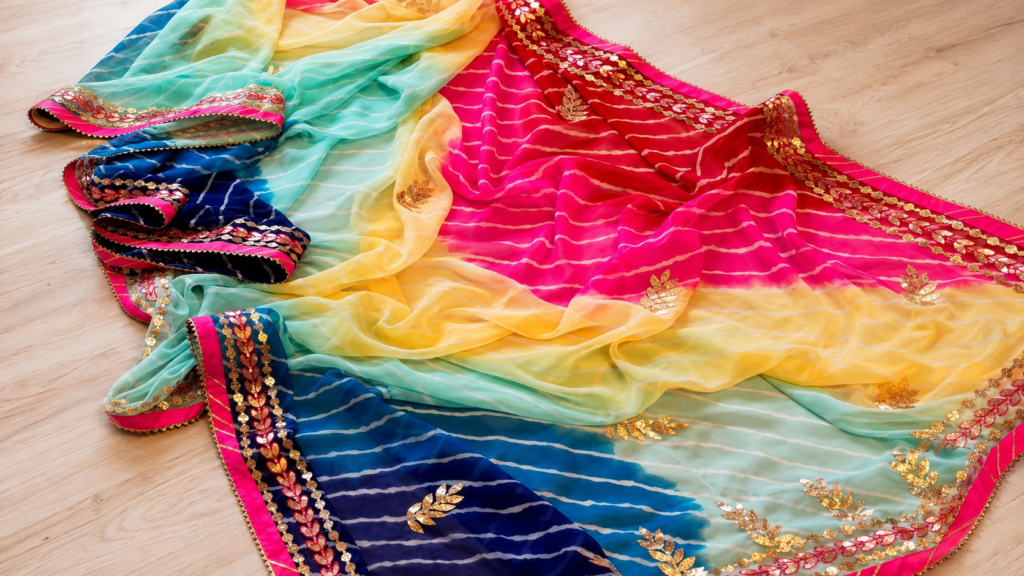
Lehariya is at its most alive during the festivals of the rains. At Teej, which welcomes the monsoon in the month of Saawan, and at the spring festival of Gangaur, women across the state dress in lehariya, gather on flower-decked swings and sing the songs of the season. There is a gentle tradition called Sinjara, in which a mother-in-law gifts a lehariya saree to a new bride as a token of love and good fortune. During the rains, many women choose the samudra leher, the pattern coloured like the sea, so that the cloth itself seems to celebrate the arrival of water.
These are among the most joyful cultural experiences Rajasthan has to give, and to see a courtyard full of lehariya on a rainy Teej morning is to watch a whole community dressed in its happiness.
For anyone drawn to Rajasthani culture and traditions, lehariya is a wonderful thread to follow, easy to find, easy to love, and steeped in meaning once you know how to read it.
Take a piece of the monsoon home
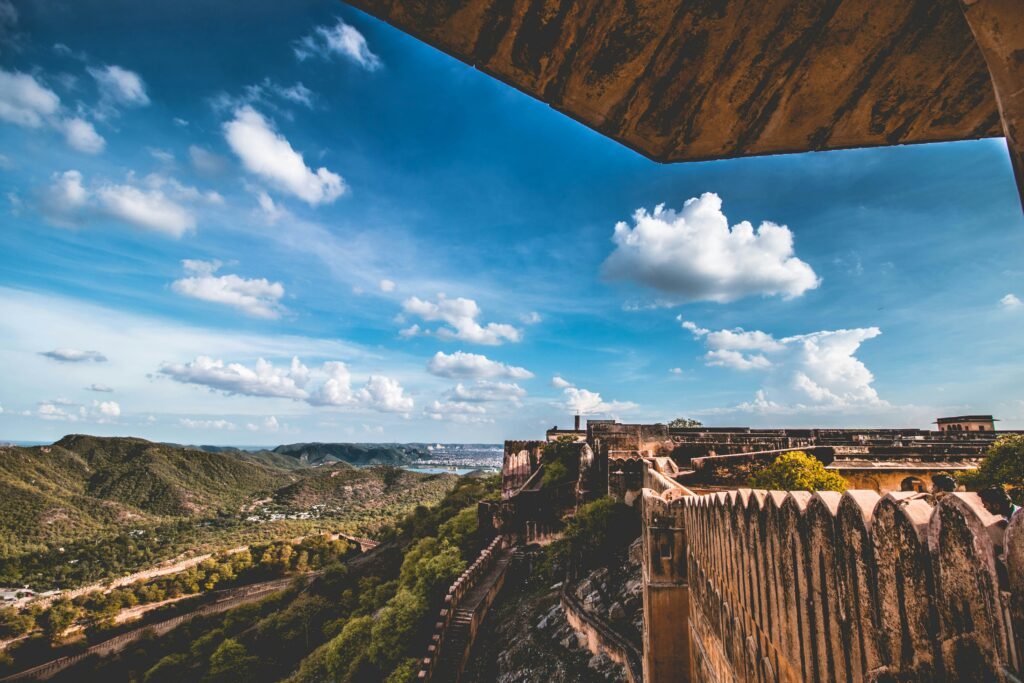
Jaipur is one of the best places to encounter the craft first-hand. The old city’s bazaars, particularly around Johari Bazaar and Tripolia Bazaar, are full of lehariya in the run-up to the monsoon festivals, and watching a shopkeeper unroll a length of freshly dyed cloth is a pleasure in itself. A scarf or a length of fabric makes one of the most beautiful things you can carry home from Rajasthan.
As a small family-run heritage stay in Rajasthan, we love pointing our guests towards the crafts that give this state its character, and helping them tell genuine handmade cloth from the cheap printed copies. Set in the heart of the walled city, our haveli sits within easy reach of the bazaars where lehariya is sold and the festivals where it comes into its own. A word from us on where to go and what to look for tends to save a good deal of guesswork. Among the boutique hotels in Jaipur, we think there are few better bases from which to fall for the textiles, the colour and the culture of the Pink City.
So when the rains arrive and the city puts on its waves of colour, come and see it for yourself. Contact us to plan your monsoon stay with us at Dera Mandawa, and let us show you the Rajasthan that only the rains bring out.
