

The Ghoomar dance is one of India’s most recognisable folk forms, admired for its circular movement and the flare of the ghagra at each turn. Performed by women in flowing skirts and veils, it expresses joy, devotion and a strong sense of community. The name comes from ghoomna, meaning to spin, which describes exactly what defines the Ghoomar dance.
Ghoomar Dance History
The Ghoomar dance’s history begins with the Bhil tribe, where it was first performed as a gesture of welcome and devotion. Over time, the Rajput community embraced the Ghoomar folk dance of Rajasthan and transformed it into a courtly art form that depicted the grace of noble life. Women performed it during grand occasions, their turning movements symbolising happiness and prosperity.
In its early days, the dance was performed around an oil lamp, a symbol of light and good fortune. Each movement was accompanied by songs that shared tales of courage, affection, and tradition. The dance was never formally taught; it was learned through participation and passed naturally from one generation to the next.
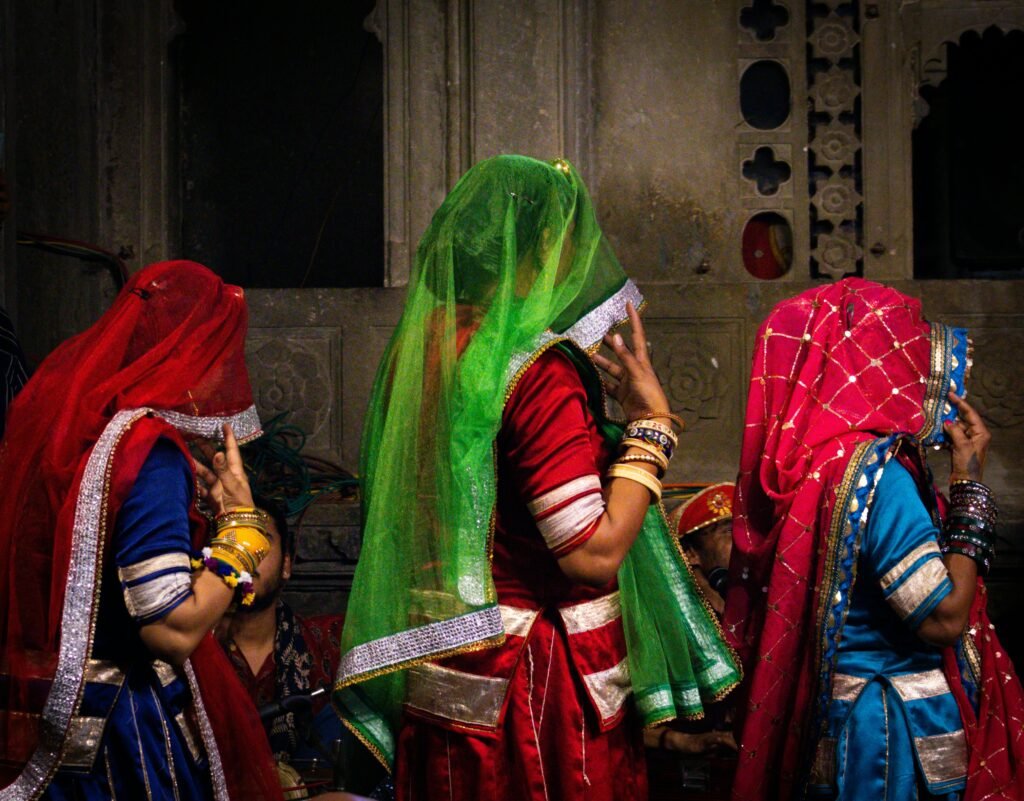
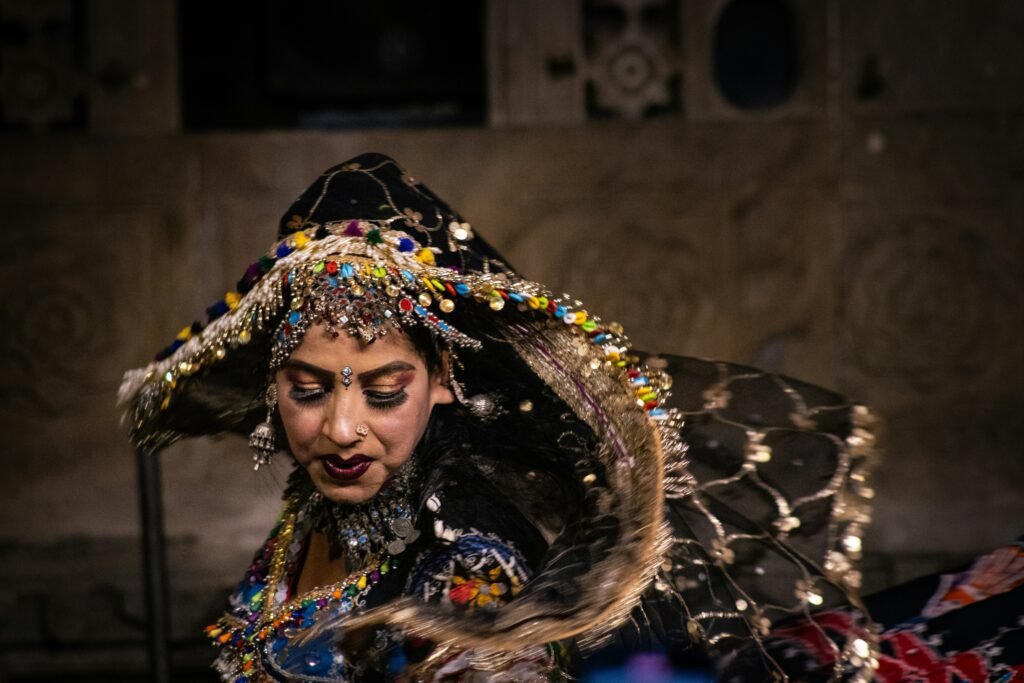
The attire plays a vital part in Ghoomar’s beauty. Dancers wear ghagras and odhnis decorated with embroidery and mirror work, while the sound of bangles adds to the music created by instruments such as the dhol and sarangi. Together they form a living portrait of Rajasthan’s craftsmanship and artistry.
How the Ghoomar Dance Is Performed
The form is simpler than it looks and harder than it seems. Dancers move in a circle, always anticlockwise, stepping and turning on an eight beat cycle while the arms sweep outward and cross in front. The pirouette that gives the dance its name comes at the end of each cycle, and the ghagra, cut with enough cloth to hold air, opens fully at that moment. That flare is the whole point of the costume.
The odhni is drawn across the face during certain passages, a convention carried over from courtly performance, then released as the tempo rises. Clapping marks the beat between turns.
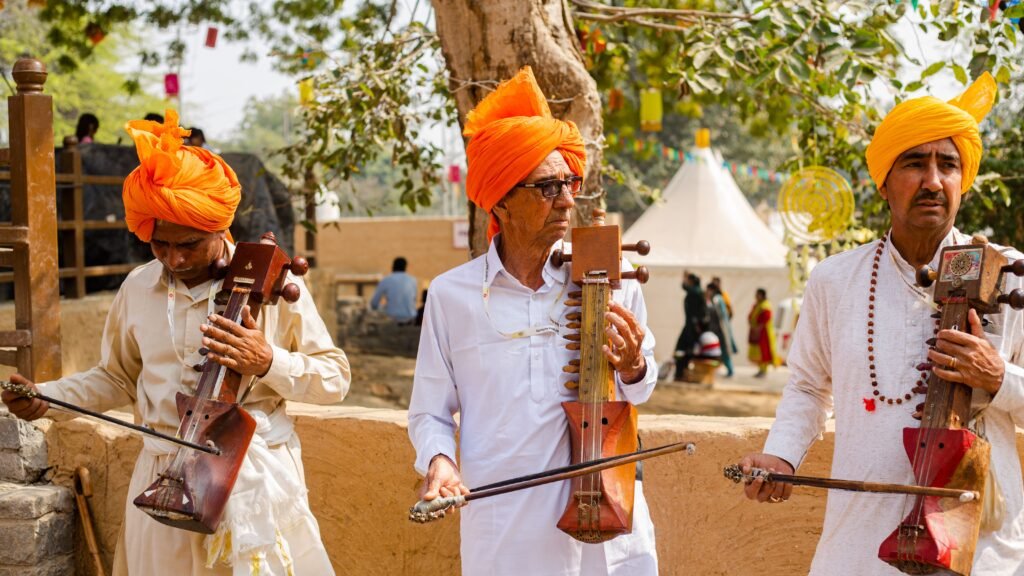
Musically it sits on the dhol and dholak, with sarangi, harmonium and nagara carrying the melody, and the songs are usually seasonal or devotional rather than composed for performance. Tempo builds gradually. A Ghoomar sequence that begins almost stately will finish considerably faster than it started.
What the Ghoomar Dance Means
The Ghoomar dance means more than performance. The circular movement represents the completeness of life, and the gathering of women shows the strength of connection within families and neighbourhoods. It is this sense of shared participation, rather than any choreography, that has kept the form alive.
The circular movement represents the completeness of life, while the gathering of women shows the strength of connection within families and neighbourhoods. It is this sense of shared participation that keeps the tradition alive.
The festival also honours the women who have preserved the art through care and commitment. Their songs and steps carry centuries of recollection, allowing Ghoomar to remain both elegant and relevant in the present.
The Ghoomar Festival
The first Ghoomar Festival was held on 19 November 2025, and it was staged simultaneously across all seven divisional headquarters of Rajasthan: Jaipur, Jodhpur, Bikaner, Ajmer, Udaipur, Kota and Bharatpur. The state-level celebration took place on the football ground at Vidyadhar Nagar Stadium in Jaipur.
Organised by the Department of Tourism, Rajasthan, it was the first event dedicated solely to this dance. A specially composed soundtrack was prepared so that performers in every division danced to the same synchronised rhythm, and free preparatory workshops ran in all seven cities, including a six day workshop at Jawahar Kala Kendra in Jaipur. Registration was free and open to the public through the tourism department portal, and spectators were encouraged to attend in traditional Rajasthani attire.
Dates for the next edition are usually confirmed only a week or two in advance. If you are planning around it, watch the Rajasthan Tourism site through late October and early November rather than booking on assumption.
Where to See the Ghoomar Folk Dance of Rajasthan Through the Year
The Ghoomar Festival is one date on the calendar. The dance itself appears far more often, and knowing where to look means you are not dependent on a single November evening.
Teej, in the monsoon month of Shravan, brings Ghoomar into the streets alongside the royal procession through the old city. Gangaur, in March and April, is the other major occasion, with performances around the City Palace processions. Both are community celebrations rather than ticketed events, which makes them the most genuine settings you will find.
Jawahar Kala Kendra programmes folk performance through the year and is worth checking whatever month you visit. The Abhaneri Festival in September, roughly ninety kilometres out on the Agra road, pairs Ghoomar with Kalbeliya and Kachhi Ghori against the Chand Baori stepwell.
Beyond these, a courtyard performance is the closest most visitors get. A private evening in a small space carries something a stadium cannot, which is proximity: you hear the anklets and the breath, and the dancers are close enough to pull you into the circle. We arrange these for guests on request, usually with two or three dancers and live dhol rather than a recording. Ask when you enquire about dates, since it needs a day’s notice.
Cultural Perseverance
Rajasthan’s traditions have survived because they adapt without losing their essence. Ghoomar is a clear example of that perseverance. The same dance that once belonged to royal courts is now taught in local schools and performed at community gatherings and various regional festivals. Its resilience lies in its continued belonging to everyone, not conserved behind glass but lived and passed on. Watching it is less about spectacle and more about understanding how culture here grows while staying rooted.
Taking Part Rather Than Watching
Ghoomar was never a spectator form. It was learned by joining a circle, and at community celebrations, visitors who want to try are usually welcomed rather than tolerated.
If you intend to take part, traditional attire helps more than it seems. A ghagra with real volume behaves completely differently from a straight skirt, and the turn will not read without it. Bangles matter too, since the sound is part of the rhythm.
Watch the feet rather than the arms when you are learning. The step pattern holds the circle together, and the arm movement follows naturally once the feet are right. Nobody expects a visitor to get it immediately, and the attempt is generally received with more warmth than a perfect performance from the sidelines would be.
Dera Mandawa: Where Culture Welcomes You
At Dera Mandawa, we open our courtyards to guests who wish to experience this time-honoured art amid candlelight and traditional songs. For us, it is a way to share what we value most: warmth, connection, and the beauty of this city’s living culture.
If you wish to see another side of the city, our feature on Hidden Places in Jaipur uncovers lesser-known spaces that carry the same sense of grace, history, and depth that define The Pink City’s timeless appeal.
Frequently Asked Questions
What is the Ghoomar Festival Jaipur?
The Ghoomar Festival Jaipur is a cultural celebration dedicated to Rajasthan’s traditional Ghoomar dance, showcasing the state’s music, art, and community spirit.
When will the Ghoomar Festival 2026 take place?
Dates for the 2026 edition of the Ghoomar Festival will usually be confirmed only a week or two in advance. If you are planning around it, watch the Rajasthan Tourism site through late October and early November.
Can visitors take part in the Ghoomar Festival, or only watch?
Registration for the 2025 edition was free and open to the public, with preparatory workshops run in all seven host cities. At community celebrations such as Teej and Gangaur, joining in needs no registration at all.
Is the Ghoomar Festival held every year?
The first edition was held in November 2025 as a statewide event across seven cities. It is intended as an annual fixture, but dates are announced close to the event, so confirm on the Rajasthan Tourism site rather than planning a trip around an assumed date.
Where can I see Ghoomar in Jaipur outside the festival season?
Jawahar Kala Kendra programmes folk performance through the year, and many heritage properties arrange courtyard performances for guests on request. A heritage hotel in Jaipur with its own courtyard is often the most intimate setting available.
Who organises the Ghoomar Festival 2026?
The festival is organised by the Department of Tourism, Rajasthan, to promote the state’s cultural heritage and artistic traditions.
What is the origin of the Ghoomar dance?
The Ghoomar dance originated with the Bhil tribe and was later embraced by the Rajput community, becoming one of Rajasthan’s most celebrated folk traditions.
What can visitors expect at the Ghoomar Festival Jaipur 2026?
Visitors can enjoy Rajasthani folk performances, traditional music, and cultural showcases that highlight Rajasthan’s artistry and themes of women’s empowerment.
Where can travellers stay to experience the Ghoomar Festival in Jaipur in comfort?
Travellers can stay at Dera Mandawa, a luxury heritage haveli in Jaipur, which provides warm hospitality and a personal connection to the city’s traditions.
Can guests see a Ghoomar performance at Dera Mandawa?
Yes, as a luxury heritage hotel in Jaipur, Dera Mandawa offers guests the chance to experience this time-honoured art right within the haveli, surrounded by peaceful courtyards and warm candlelight.
Why should travellers visit the Ghoomar Festival Jaipur 2026?
The festival offers an authentic glimpse into Rajasthan’s living culture, combining traditional dance, music, and craftsmanship into a single unforgettable experience.
