

Say tie-dye to most people. They picture a swirl of rainbow colour on a 1960s t-shirt. India has been at the same trick for far longer, with a great deal more precision. Bandhani is the local version, a length of cloth scattered with hundreds of tiny dots, every one placed by hand. The name gives the game away, since bandhani comes from an old Sanskrit word meaning to tie, which is the whole craft in a single verb. The Bandhani Jaipur is known for runs bold and bright, the sort of fabric you cannot miss at a wedding. It looks almost plain from across a room. Up close, the labour behind it is staggering.
How is Bandhani Made
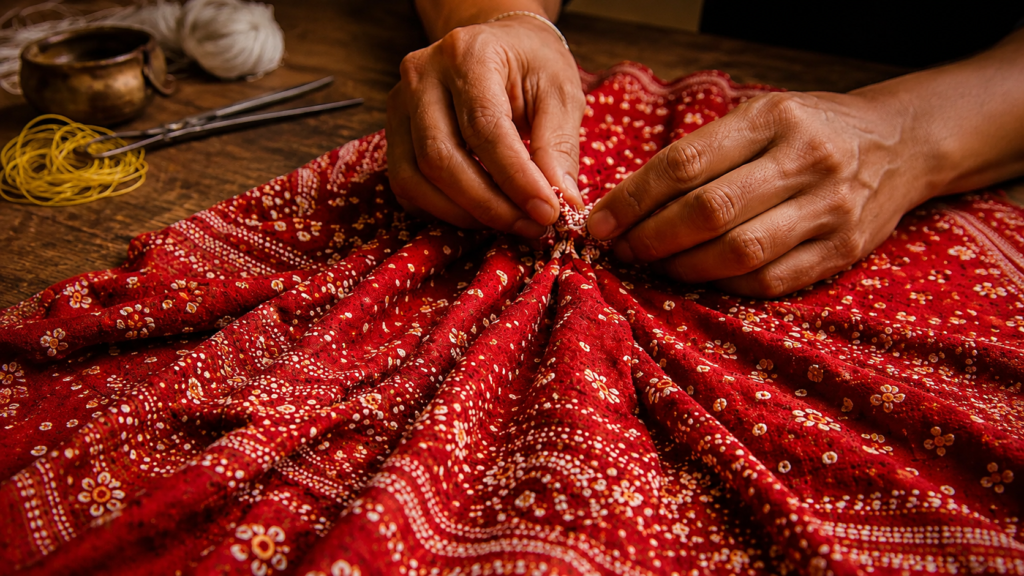
The method is ancient, worked entirely by hand. A worker pinches the cloth into a minute point, then binds it tightly with thread, time after time, until a single length holds hundreds or even thousands of ties. This is a resist dye, a simple idea carried out with enormous patience, where the tied points keep their first colour while everything around them drinks in the dye.
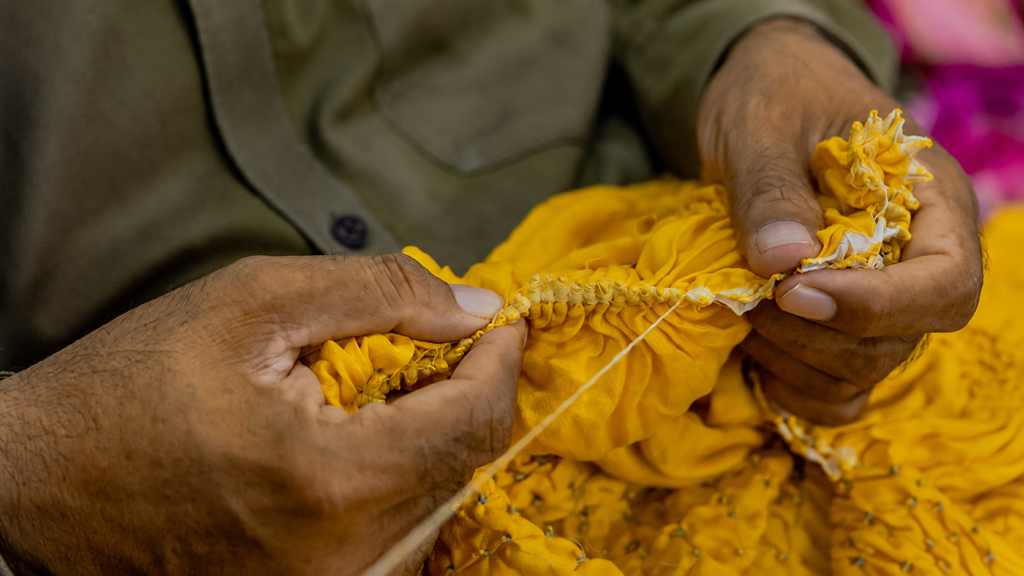
In parts of Rajasthan, the workers slip on a pointed metal ring to pluck the fabric faster. Pale shades go on first, deeper ones later, with fresh ties added between each dip. Every new colour means another round of tying, then dipping, so a piece with several shades has been through the whole slow process many times over. Only when the threads come loose does the finished pattern show itself.
Fabric matters as much as skill. Fine cotton, silk, chiffon, and georgette all take the tiny ties well, because a thin, close weave holds a point better than heavy cloth. The worth of a piece rests on the dots themselves. Small, even, tightly packed dots take real mastery, while large, scattered ones mark simpler work.
The dots even carry names, from the single ekdali to clustered groups of three or four. A single fine saree can hold many thousands of them, which is why good bandhani has never been cheap the same patience that goes into tying Rajasthan’s monsoon textile, lehariya, into its diagonal waves.
Bandhani Jaipur Style: Bold, Bright, and Unmistakable
Every bandhani region has its own accent. Gujarat, with the Kutch desert to the west in particular, is known for extremely fine, densely packed dots. Jaipur and the rest of Rajasthan pull the other way, towards larger dots, stronger colour, red against yellow, saffron against green, pairings that carry clear across a crowded courtyard. Among Rajasthani textiles, this is the craft most bound up with celebration. A wedding here without it is almost unthinkable.
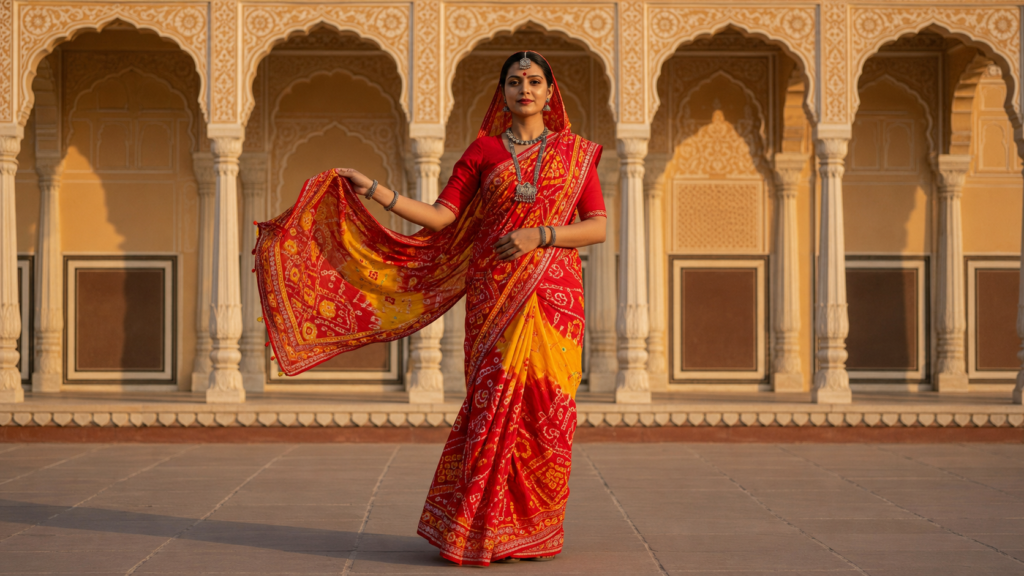
Colour does real work in this setting. Red has long stood for marriage and good fortune, which is why a bride’s tie and dye saree or bandhani saree is so commonly a deep red flecked with white. Yellow points to spring, to fresh starts, while darker shades suit more sombre days. Those colours once came straight from the land, from flowers, pomegranate skins, crushed minerals, though many workshops now reach for modern dyes that hold faster.
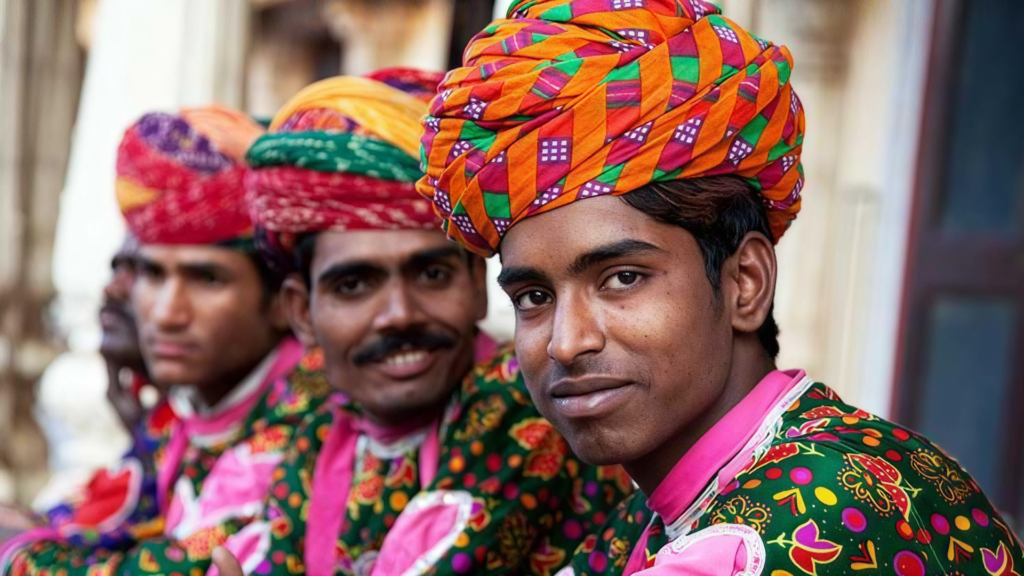
Men belong in the story too. The bandhani turban, or safa tying, once signalled which community a man came from through its pattern, its colour, a kind of dress code read at a glance.
A Craft Older Than It Looks
For all its daily use, bandhani has a very long past. Dyeing in India goes back thousands of years, as far as the cities of the Indus Valley. The dotted patterns anyone would recognise today turn up in the painted caves at Ajanta, made around the sixth century, while a bandhani garment appears in a royal biography from the seventh, worn by a princess at her wedding. Early on, the cloth dressed royalty, made with costly ingredients, before it slipped into everyday village dress across the region.
Traders carried it far beyond its home, along the old routes that linked this part of the world to Central Asia and the Middle East. Few things in a modern wardrobe can claim a history that deep.
How to Tell Real Bandhani from Printed
Machines have learned to mimic the look, printing rows of neat dots onto cheap cloth. A trained eye is not fooled for long. Real bandhani carries small imperfections, dots that shift a little in size, faint puckers where the thread pulled tight, a design that shows through on the back.
The printed sort is too tidy, too flat, blank on the reverse. Its close cousin, lehariya, uses the same tying trick to make diagonal waves, not dots. The two are easy to confuse until you have seen both in the hand. Good bandhani is kept for years, handed down as an heirloom, not worn once.
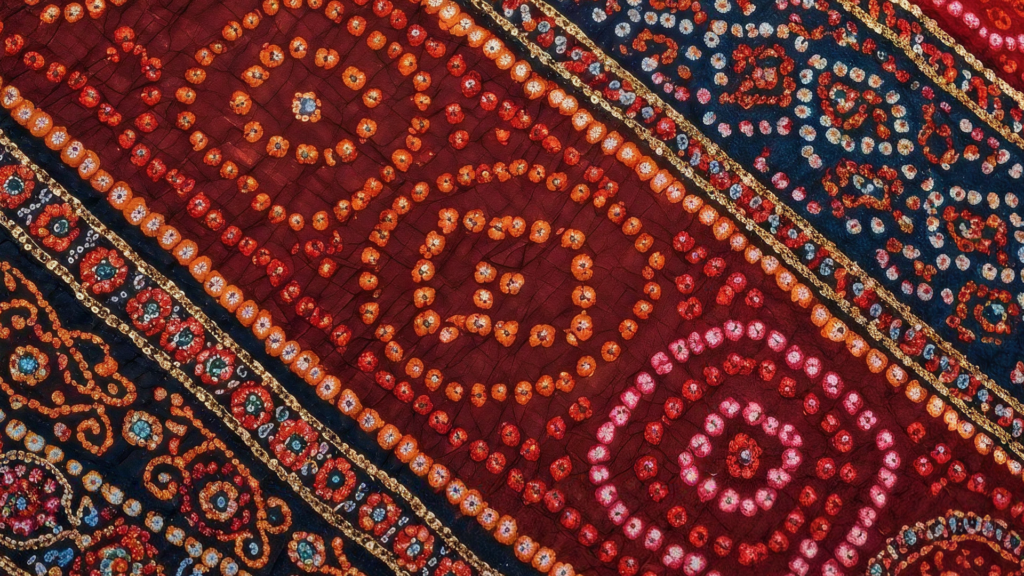
Behind every real piece sits a family. Most come from the Khatri community of dyers, who have carried the craft across Rajasthan and neighbouring Gujarat for generations. Much of the tying is slow, close work done at home, passed from one hand to the next. It faces the same squeeze as many handmade crafts, with printed copies selling for far less. This is where staying in the old city helps.
We point guests who are curious towards the workshops, the market lanes where the real cloth is tied and sold, away from the polished shops moving prints to people in a hurry. Watching a plain length of fabric turn into a field of dots does more for your eye than any label ever could.
Difference Between Bandhani and Lehariya
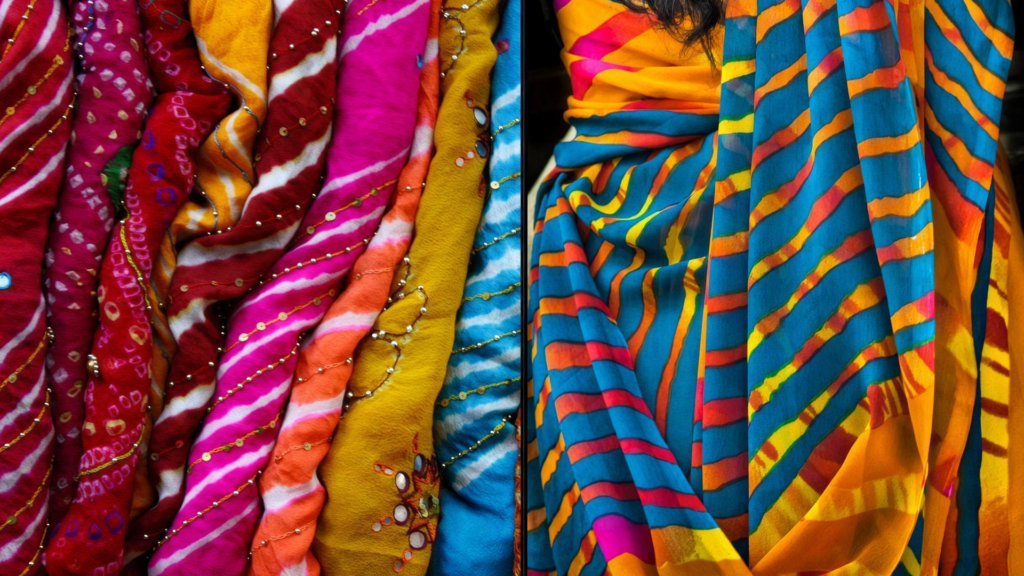
Bandhani and lehariya share the same resist-tying method, but the pattern gives each away. Bandhani forms small, distinct dots across the cloth, tied point by point. Lehariya instead uses diagonal folds bound along the fabric’s length, producing continuous wave-like stripes rather than dots. The two are easy to confuse from a distance, but a close look at the pattern dots versus waves settles it immediately.
Where to Buy Authentic Bandhani in Jaipur
Skip the polished shops selling machine-printed copies to visitors in a hurry. The real cloth is tied and sold in the old city’s market lanes and small family workshops, mostly run by the Khatri community of dyers. Staying nearby makes this easier we point our guests toward the workshops and lanes we trust, not the tourist-facing stores fast-tracking prints to people who don’t know the difference.
Come See It Being Tied
A tie and dye saree folded on a shelf is a lovely thing. Seeing how it earns those dots, one tie at a time, changes the way you look at it for good.
Planning a trip to Jaipur? Come stay with us. Dera Mandawa is a family-run heritage haveli in the heart of the old city, a short walk from the bazaars and a genuine home from which to see it all. Write to us with your dates, and we will take care of the rest, from your room to the little things that make a stay worth remembering. Our door is open whenever you are ready.
Frequently Asked Questions
Is it a flaw if the dots look slightly uneven?
Far from it. Hand-tying means no two dots come out identical, so small shifts in size and spacing are the fingerprint of the real thing. A genuine tie and dye saree will never look machine-perfect, and that faint wobble is exactly what you are paying for.
Why is bandhani sometimes sold still tied up in its knots?
Tradition, plus proof. Cloth left in its tied state shows the buyer the work was done by hand, knot by knot. You open it yourself by gently pulling the fabric, which is oddly satisfying, though the tiny puckers stay until the first wash stretches them out.
Will the colours run the first time I wash it?
They can, especially with older natural dyes, so treat an early wash with care. Cold water, no soaking, no wringing, and a separate rinse the first time round. After that, a good piece settles down and holds its colour for years.
Is bandhani only bridal wear?
Not at all. It dresses brides, yes, but it also turns up in everyday dupattas, in festival clothes, and famously in the men’s turban, the safa, once worn to signal a man’s home region. Among Rajasthani textiles, it is one of the most widely worn, from grand weddings to ordinary afternoons.
Is bandhani the same as lehariya?
They are cousins, not twins. Both use the tie-and-dye method, but bandhani makes dots while lehariya makes diagonal waves, tied and rolled a different way. If you see stripes, not spots, you are looking at lehariya.
Can you help me find real bandhani while I am in Jaipur?
Happily. The bandhani Jaipur is known for is easy to find and easy to fake, so knowing where to look matters. We point guests towards the market lanes and workshops where the cloth is genuinely hand-tied, away from the polished shops selling prints, and can arrange a proper look at how it is made.
