

Jaipur is a difficult city to photograph badly and that is half the trouble. The pink sandstone, the painted gateways and the honeycomb palace fronts have been shot so many million times that most people fly home with the exact postcard already sitting in a thousand other camera rolls. The monsoon is the season that breaks the pattern. Between July and September, the light softens, the stone changes colour and water returns to the corners of the city. For anyone who travels with a camera, Jaipur monsoon photography is what turns another postcard into a frame that looks like nobody else’s.
A little orientation first, for anyone new to this part of the world. Jaipur is the capital of Rajasthan, the desert state in India’s north-west, and its walled old town has been washed a warm terracotta since the nineteenth century, which is where the city’s famous pink nickname comes from. That colour is what most visitors come to capture and it behaves very differently under monsoon cloud than under a hard dry-season sun.
What the rain does to the light
The real enemy in Jaipur is a cloudless noon. With the sun straight overhead, the sandstone bleaches to a tired beige, and every carved recess fills with a hard black shadow. The Hawa Mahal loses most of its depth in that glare. During the monsoon, the softened light brings out the intricate latticework and the rich pink sandstone, making it one of Jaipur’s most rewarding photography subjects. Monsoon cloud fixes the problem at a stroke. A grey sky works as an enormous softbox, spreading the sun into an even light that saturates the pink and lets the carving read properly, edge and hollow and shadow all present.
Wet stone earns its keep as well. Sandstone soaks up rain and darkens, so a wall that looked chalky and flat at midday turns deep and full an hour after a shower. The best time to photograph the Hawa Mahal is early morning, just after a shower, while its front still catches the low sun, or shoot down from one of the small rooftop cafes across the street with a glass of chai going cold at your elbow.
7 Jaipur Photography Spots for Monsoon Season
Rajasthan is a desert country and its water is seasonal. For half the year, the lakes lie low and brown, then the rains fill them and the map of the city redraws itself. These are the Jaipur photography spots that gain the most when the rain comes.
Hawa Mahal
The Hawa Mahal loses most of its depth in dry-season glare. Under monsoon cloud, the softened light brings out the intricate latticework and the rich pink sandstone. The best time to photograph it is early morning, just after a shower, while its east-facing front still catches the low sun. Or shoot down from one of the small rooftop cafes across the street with a glass of chai going cold at your elbow.
Amber Fort and Maota Lake
This counts for most at the Amber Fort, the cream and honey palace stacked up a hillside north of town. Maota Lake sits at its foot and a full lake holds the whole fort upside down in the water while the rain turns the hills behind it green. Arrive before the wind starts to work the surface and the mirror stays intact. For Jaipur monsoon photography, this reflection is the shot most people come for.
Jal Mahal
The Jal Mahal plays the same trick further along the Amber road, a low sandstone palace stranded in the middle of Man Sagar Lake. In a dry spring, it looks half-beached. A few weeks into the monsoon, the water has climbed its walls and the building seems to sit on the surface. There is little to do but shoot it from the bank and let the flat morning light carry the picture.
Panna Meena ka Kund
The old stepwell below the fort gains something in the rains too. Its criss-crossing stairs already fold into a neat geometric square and the monsoon fills the pool at the bottom to hand you a second, watery half of the pattern.
The Bazaar Lanes
The lesson most people miss is to look down as much as up. A flooded gutter in a bazaar lane will double a painted doorway or a run of shop awnings. Those street-level images are usually livelier than the monument overhead and they are some of the most rewarding Jaipur photography spots in the rains.
A blank blue sky is a poor companion for a building. It leaves nothing behind the architecture and flattens the whole image. Monsoon weather gives you the reverse gift, piling up grey and silver cloud that puts real drama above a fort wall. Nahargarh Fort high on the ridge, is where this pays off best. Late in the afternoon, once a shower has passed through, the entire old city lies spread beneath the ramparts under a heavy sky and a shaft of sun dropping through a break in the cloud will do most of your work for you.
There is also the question of the company. The tour coaches dwindle in the monsoon season, which leaves the City Palace courtyards and the old bazaar gates clear enough to compose without a stranger drifting through every shot. That quiet is one of the underrated gifts of Jaipur monsoon photography.
Best Places to Visit in Jaipur When the Rain Comes
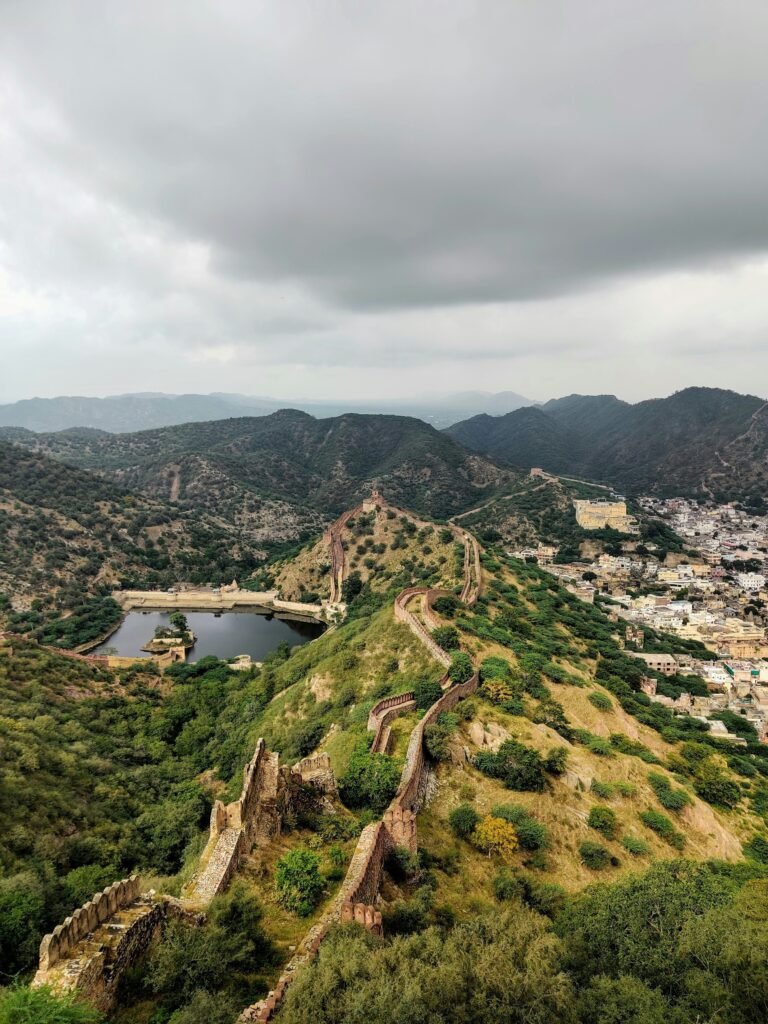
Rajasthan is a desert country, and its water is seasonal. For half the year, the lakes lie low and brown, and then the rains fill them, and the map of the city redraws itself. This counts for most at the Amber Fort, the cream and honey palace stacked up a hillside north of town. Maota Lake sits at its foot, and a full lake holds the whole fort upside down in the water while the rain turns the hills behind it green. Arrive before the wind starts to work the surface, and the mirror stays intact.
The Jal Mahal plays the same trick further along the Amber road, a low sandstone palace stranded in the middle of Man Sagar Lake. In a dry spring, it looks half-beached. A few weeks into the monsoon, the water has climbed its walls, and the building seems to sit on the surface; there is little to do but shoot it from the bank and let the flat morning light carry the picture.
The lesson most people miss is to look down as much as up. A flooded gutter in a bazaar lane will double a painted doorway or a run of shop awnings, and those street-level images are usually livelier than the monument overhead. Even the old stepwell below the fort, Panna Meena ka Kund, gains something in the rains. Its criss-crossing stairs already fold into a neat geometric square, and the monsoon fills the pool at the bottom to hand you a second, watery half of the pattern.
Skies, greenery and empty frames
A blank blue sky is a poor companion for a building. It leaves nothing behind the architecture and flattens the whole image. Monsoon weather gives you the reverse gift, piling up grey and silver cloud that puts real drama above a fort wall. Nahargarh Fort, high on the ridge, is where this pays off best. Late in the afternoon, once a shower has passed through, the entire Pink City lies spread beneath the ramparts under a heavy sky, and a shaft of sun dropping through a break in the cloud will do most of your work for you.
There is also the question of the company. The tour coaches dwindle in the monsoon season, which leaves the City Palace courtyards and the old bazaar gates clear enough to compose without a stranger drifting through every shot.
Jaipur Monsoon Photography Tips for Visiting
None of it counts for much if your gear drowns, though the risk in Jaipur is manageable rather than dramatic. A couple of freezer bags, a lens hood and a microfibre cloth will see you through everything short of a proper deluge, and the rain here has a habit of saving itself for the afternoon, so mornings are usually clear enough to work in. When it does begin to fall, fight the urge to pack away, because the slick stone and the standing water are the whole reason for coming in this season.
Of all the things to do in Jaipur, this kind of light-chasing lives or dies by an early start, and that comes down to where you wake up. A room inside the walled city, a short walk from the bazaars and a quick drive from the forts, lets you be out at first light with the lanes still wet and empty. If you’re planning your trip during the monsoon in Jaipur, our seasonal guide covers everything from weather and sightseeing to local experiences before you set out on your own Jaipur monsoon photography trip.
This is where staying at a place like Dera Mandawa, an old family haveli in Jaipur, starts to make sense. The Hawa Mahal is a short walk away, and the forts are a manageable drive, so you can be out shooting at first light and back before the day heats up.
If you’re planning your trip during the monsoon in Jaipur, our seasonal guide covers everything from weather and sightseeing to local experiences before you set out with your camera.
Want to catch Jaipur before the crowds this monsoon? Get in touch to book your stay with us at Dera Mandawa.
