

A first trip to Jaipur is a sprint. The fort at Amer, the palace, the observatory and the famous windows on the bazaar all get ticked off in two or three busy days, and the city lodges in the memory as a blur of ramparts and ticket queues. The second trip is where the place starts to make sense. Returning travellers already know the layout, have nothing left to prove at the big monuments, and finally have time for the offbeat places in Jaipur, the lanes, workshops, cinemas and royal cremation ground that first-timers drive straight past.
Most end up liking the old city more the second time, because they stop visiting it and start using it. Here is where that second look pays off.
Offbeat places in Jaipur for a second look
Five places that reward a returning visitor, none of them on the standard first-trip circuit.
1. Gaitore ki Chhatriyan
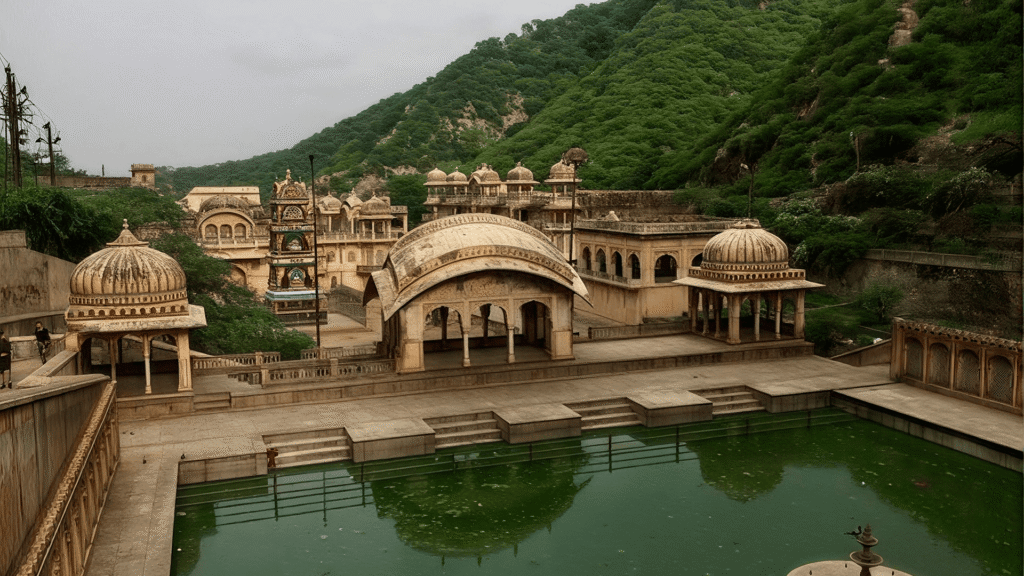
Gaitore ki Chhatriyan one of the most atmospheric offbeat places in Jaipur lies in a narrow valley beside the road to Amer road to Amer lies the cremation ground of Jaipur’s rulers, a crowd of carved cenotaphs in marble and sandstone. The name is believed to come from Gaye ka Thor, the resting place of departed souls. Sawai Jai Singh the Second, the city’s founder, chose the ground himself, and his own white marble cenotaph, carved with peacocks, is the finest of them. One ruler is missing. Sawai Ishwari Singh was cremated inside the City Palace complex, not here. The site opens from half past nine until five.
2. Galtaji
Of all the offbeat places in Jaipur, this is the one that feels furthest from the city, though it lies only about ten kilometres east of the centre. Galtaji temple complex fills a narrow crack in the Aravalli hills, fed by a natural spring that runs down through seven stepped bathing tanks, or kunds. Troops of monkeys outnumber the pilgrims on most days and treat any visible snack as a gift. Above the gorge, a small Sun temple sits on the hill between Galta and the city, and the light from up there in the late afternoon is worth the climb.
3. Jawahar Kala Kendra
The arts centre on Jawahar Lal Nehru Marg was designed by the architect Charles Correa in 1986 and completed in 1992. Its plan is a grid of nine squares, each tied to a planet in the Hindu navagraha, which echoes the nine-block plan Jai Singh the Second used for the walled city itself. Inside are galleries, a library, theatres and an open-air amphitheatre, and the programme of exhibitions and performances changes through the season, which makes it one of the few offbeat places in Jaipur that is different on every visit.
4. Raj Mandir
Near MI Road stands one of the grandest single-screen cinemas in India, opened on 1 June 1976. Designed by W. M. Namjoshi in an Art Moderne style, it seats 854 people under pink, swirling, meringue-like ceilings. The nine stars on the facade stand for the nine gemstones of the navaratna, a nod to the jewellers who built it. Watching a Hindi film here, with the audience cheering the hero, is a better introduction to modern Jaipur than any museum.
5. Sanganer
Around sixteen kilometres south of the centre, the town of Sanganer has two crafts worth a morning. The Kagzi community makes handmade paper from cotton rags and waste, pressing the pulp into sheets and polishing them smooth with stones. The town is also known for Sanganeri block printing, delicate flower sprigs pressed in colour onto white or pale cloth from carved wooden blocks, and several workshops welcome visitors to watch or try.
A Jaipur heritage walk through the old lanes
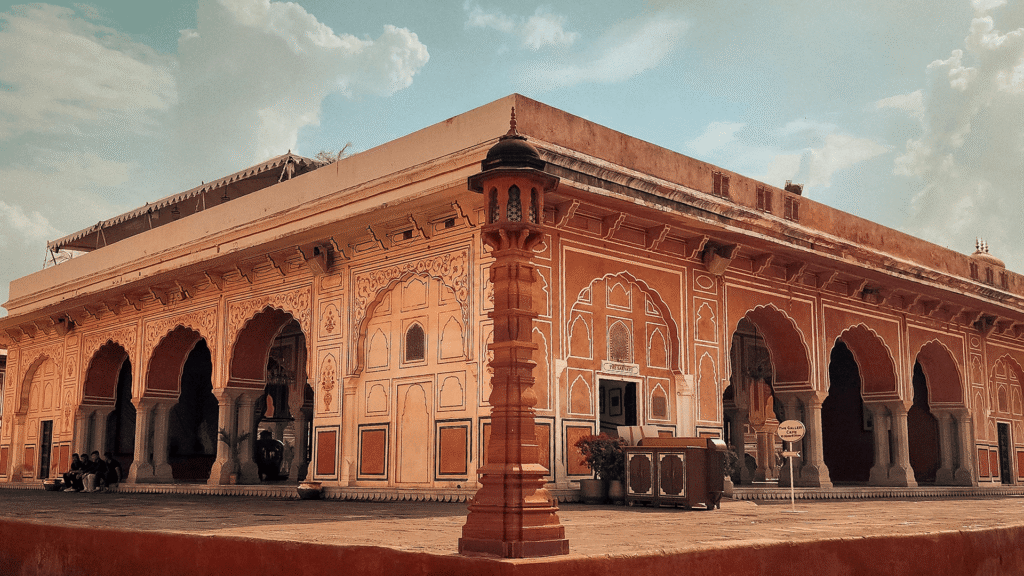
The surest way to see the walled city properly on a return trip is on foot. A Jaipur heritage walk makes sense of a plan that is easy to miss from a car. The old city was laid out in nine blocks, crossed by straight bazaars that meet at great squares called chaupars. Badi Chaupar and Choti Chaupar each have temples standing at their four corners, and between them runs Tripolia Bazaar, the old spine of the city.
The real pleasure of a Jaipur heritage walk lies in the side streets, each called a rasta, many still named after the trade that once filled them. Thatheron ka Rasta belonged to the metalworkers who beat brass and copper into pots, and Khajane Walon ka Rasta to the marble carvers. Maniharon ka Rasta still rings with the sound of lac bangles being made and sold. Nataniyon ka Rasta, named for the performers who once lived there, is now better known for its pani puri stalls. Behind plain gateways sit small temples with fading frescoes, old community wells and havelis whose painted doorways most passers-by never look up to see.
Reading the lane names is a lesson in how the city once worked, trade by trade and street by street
Shopping in Jaipur, one lane at a time
First-time visitors tend to buy everything in a single crowded bazaar. Shopping in Jaipur goes better on a return visit, because the old city sorts itself by trade, and the best buys come from the lanes where things are made.
- Johari Bazaar is the jewellers’ street, with numbered pink shopfronts selling gems, silver, bandhani and bangles. Gold, silver and kundan work fill the side lanes too, Haldion ka Rasta and Gheewalon ka Rasta among them.
- Tripolia Bazaar is the place for brassware, iron pots and kitchenware, the everyday metal of a Rajasthani kitchen.
- Maniharon ka Rasta, just off Tripolia, is where the Manihar families make lac bangles by hand over small coal fires. There is no machinery involved, and a single dozen can take six or seven hours.
- Kishanpol Bazaar sells ittar, the traditional oil-based perfume, along with spices and carved wooden figures.
- Chaura Rasta, the wide street, is the city’s bookshop row, with quilts and hand-printed paper alongside the second-hand books.
- Bapu Bazaar and Nehru Bazaar are the streets for cotton textiles and mojari, the curled-toe leather slippers of Rajasthan.
Knowing the lanes changes how shopping in Jaipur feels. A bangle bought from the man who rolled the lac, or a brass pot from the street where pots have always been beaten, carries more of the city home than anything from a showroom near the forts.
Why haveli hotels in Jaipur suit a return trip
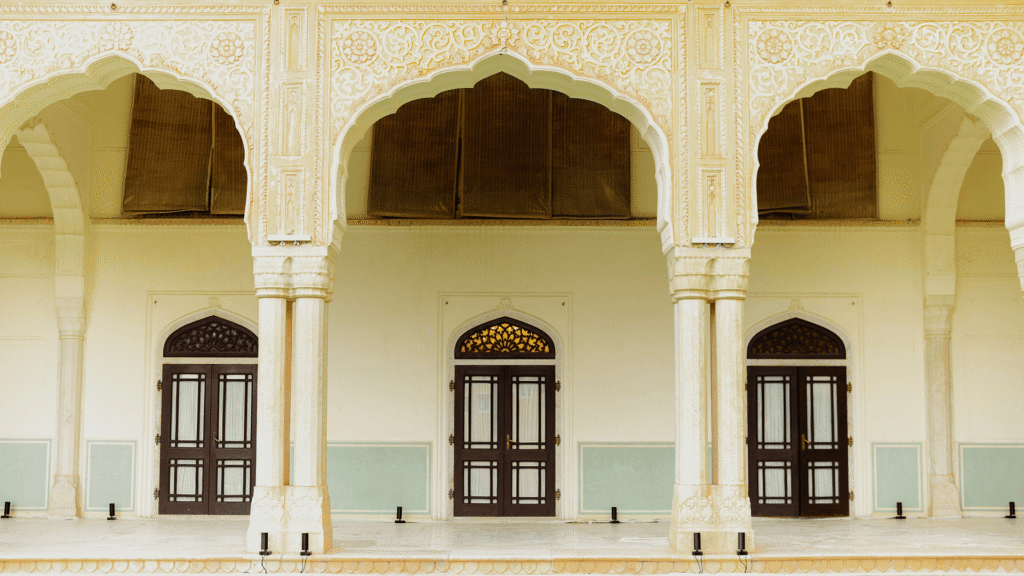
Where to stay shifts on a second visit. A first trip is usually booked around a pool, a car park and an easy drive to the forts. A return trip is built around the lanes, which makes haveli hotels in Jaipur the natural base. Most were family homes long before they took guests, built around open courtyards with carved jharokhas and rooms that differ from one another because nobody planned them as hotel rooms. Many sit inside or just outside the walled city, so the morning walk starts at the front door and not at the end of a taxi ride.
The hosts make the bigger difference. In most haveli hotels in Jaipur, the family still lives on site and knows which lane sells the best bangles, which temple is worth reaching before the crowds, and which day a particular workshop is open. Two practical points are worth checking before booking. Old houses have stairs and few rooms, so the better ones fill early in the cooler months. And lanes in the old city can be too narrow for cars, so it is worth asking how close a driver can reach the gate.
A house worth coming back to
Our home sits just beyond Chandpole Gate, within about two kilometres of City Palace, so much of the walk above starts at our door. We have lived here for generations, and the guests who return to us tend to arrive with a list of lanes in place of a list of monuments. No two of our suites are alike, so a return guest can try a different one each time. When the dates are set, write to us and tell us what the first visit missed.
Frequently Asked Questions
Is Jaipur worth visiting a second time?
Yes. A first visit rarely gets past the four or five headline monuments, which leaves the lanes, the crafts and the city’s daily life almost untouched. A return trip timed for a festival, such as the kites of Makar Sankranti in mid-January, shows a different city again.
Which offbeat places in Jaipur are free to visit?
Galtaji charges no entrance fee, though visitors carrying cameras are expected to pay a small charge. The trade lanes of the old city, the chaupars and the bazaars cost nothing to walk.
How long does a Jaipur heritage walk take?
A guided walk through the old city usually runs two to three hours, and private guides charge roughly ₹2,000 to ₹2,500 for one. Any time after eight in the morning works, and the cooler months from October to March are kindest for it.
Do you need a guide for the old city?
Not to find your way, since the grid of straight bazaars is easy to follow. A good guide earns the fee by opening doors, explaining the lane names and pointing out the temples and wells hidden behind plain gateways.
Is bargaining expected when shopping in Jaipur?
In the old bazaars, yes. A first price is an opening position, and naming a lower figure politely is normal. Upmarket showrooms and government emporiums work on fixed prices.
How do you get to Galtaji?
By car, it is a short drive out along Galta Road. The more rewarding way is on foot from the city side, a walk of about thirty minutes over the hill, past the Sun temple, before dropping into the gorge.
When is Galtaji open?
The temple complex is open daily from early morning until late evening, roughly five in the morning until nine at night. Late afternoon is the best time, when the light on the hill is softest.
What should you buy in Jaipur on a return visit?
Things that are hard to find elsewhere and easy to trace to their maker. Handmade paper from Sanganer, lac bangles from the lane where they are rolled, and a bottle of ittar from Kishanpol all travel well.
Can cars reach haveli hotels in Jaipur?
Not always to the door. Some sit-down alleys are too tight for a car, so the last stretch is on foot. Ask the hotel before arrival so the driver knows where to stop.
Can Dera Mandawa help plan a return visit?
Yes. Tell us what you saw the first time and what you would like to see now, and we will suggest the lanes, workshops and days that suit. We are glad to help repeat guests find a different city on each stay.
What are the best offbeat places in Jaipur?
For a return visit, Gaitore ki Chhatriyan, Galtaji, Jawahar Kala Kendra, Raj Mandir and the craft workshops of Sanganer show a side of the city most first-time visitors miss.
