

Walk through the old city, where one colour keeps catching your eye. Cobalt on a milk-white ground, painted into flowers, birds, looping vines. This is the blue pottery, Jaipur. For all its delicate looks, it hides a real oddity. Almost none of it is made from clay. Guests who stay with us tend to assume it is a local take on the willow-pattern china back home, the sort a grandmother keeps for best. The truth runs stranger, far older, crossing deserts and empires before it settled here in the Pink City, as it is known for the rosy walls of its old quarter.
What Makes the Blue Pottery, Jaipur Different From Everything Else
Most pottery starts with clay. Anyone who has watched The Great Pottery Throw Down knows the routine, a wet lump spinning on a wheel, thumbs pressed into the middle. Not so with the blue pottery Rajasthan is known for. The dough here is mixed from ground quartz, powdered glass, a little fuller’s earth (a soft, absorbent mineral long used to clean raw wool), gum and water. No wheel, no river clay. Because so little holds it together, the finished piece stays brittle, which is part of why each one feels like a small triumph.
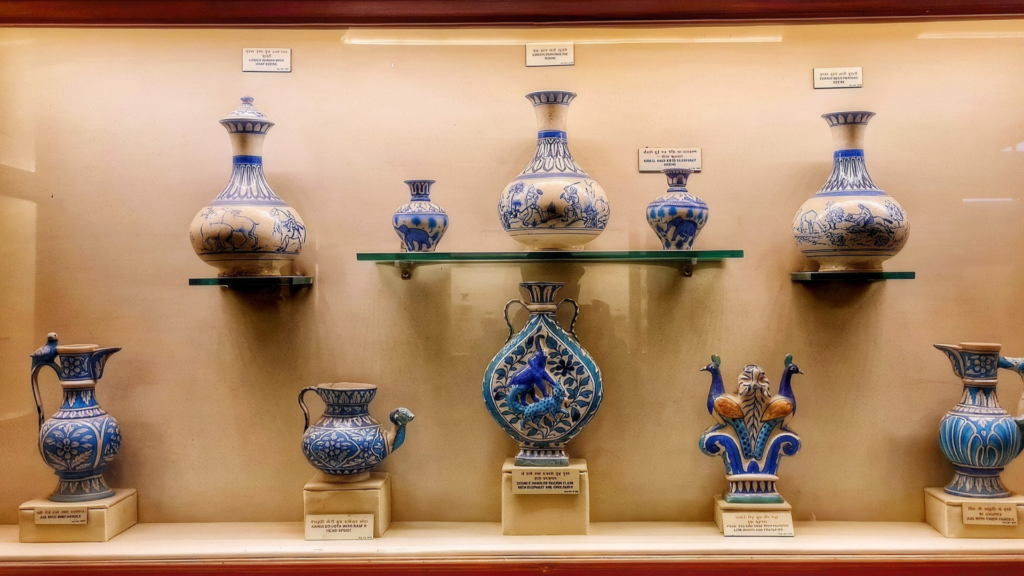
The colour comes from minerals too. That deep blue is cobalt oxide, the very pigment behind Chinese porcelain, while the softer greens come from copper. Each piece is painted by hand, sealed under a glassy glaze, then fired at a low temperature. One wrong turn of the heat can crack the whole batch.
A Craft That Crossed Half the World
The technique was never Indian to begin with. Its origins lie in Persia and Central Asia, where glazed blue tiles ran across the domes of mosques, palaces, and tombs from around the fourteenth century. Mughal rulers carried the taste for it into India. Workshops near Delhi kept the tradition alive for generations.
Jaipur came to it late. The craft reached the city in the nineteenth century under Sawai Ram Singh II, the ruling maharaja, or prince, who did more than most to fill his capital with artists of every kind. One well-loved story explains the arrival.
During a kite-flying contest, the king watched two visiting brothers cut down his own champions with ease. Their trick was a blue-green glaze, the same glassy coating from their pottery, smeared onto their kite strings for extra bite. Charmed, he asked them to stay on as teachers. Whether every detail holds up hardly matters, because it is the kind of tale Jaipur likes to tell about itself. It suits a city that has always loved a clever pair of hands.
How the Blue Almost Disappeared
By the middle of the twentieth century, the story nearly ended. Cheap factory ceramics undercut the potters as raw materials grew dear. By the 1950s the craft had all but vanished from Jaipur. Rescue came from one determined man. Kripal Singh Shekhawat, a painter trained in Bengal, later in Japan, set out to learn the old methods, then pass them to a new generation. He widened the palette from two colours to more than twenty. His name now sits beside the craft the way Wedgwood sits beside English china.
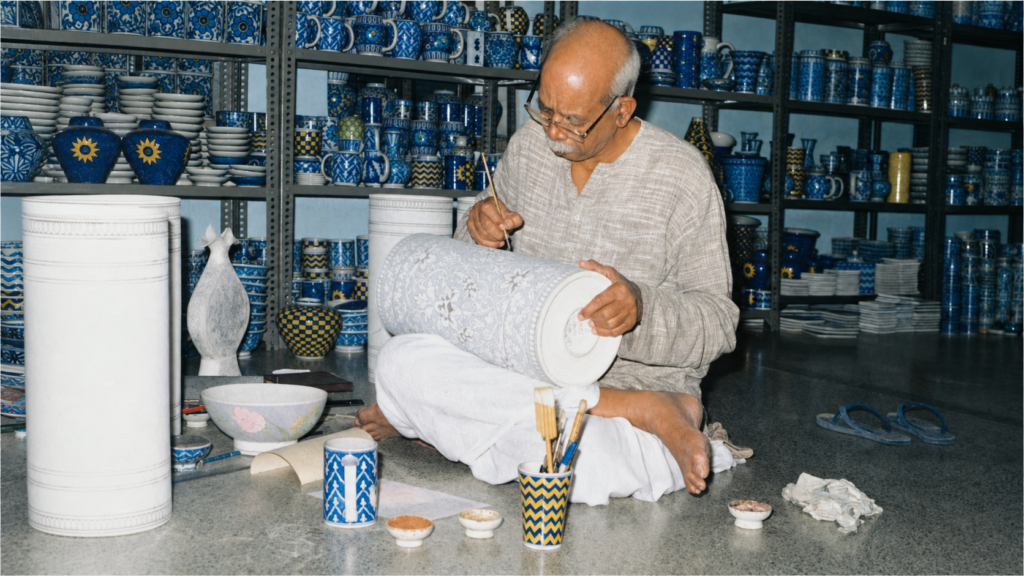
Shekhawat did not do it alone. Two formidable women stood behind the revival, the social reformer Kamaladevi Chattopadhyay and Rajmata Gayatri Devi, the former queen of Jaipur, whose title rajmata means queen mother. In 1963, they set up a crafts centre in the city to train potters, then sell their work. Gayatri Devi, famous in her day for her chiffon saris and her charm, saw a practical snag as well. Families had long guarded their recipes as secrets, so the new training helped that knowledge spread past a handful of workshops. For his life’s work, Shekhawat was awarded the Padma Shri, one of India’s highest civilian honours.
Why It Still Counts as the Real Thing
These days the craft carries a Geographical Indication tag, a legal mark granted by the Government of India. The idea works much like the rules around Champagne or Parmesan in Europe. A name is bound to a place, so only pottery made here, in this style, can properly claim it. Among the many Jaipur handicrafts sold to visitors, this one holds that formal stamp of origin, a real source of pride for the families who keep it alive. That same recognition carried the blue pottery Rajasthan exports into design shops in London and hotel lobbies across the Gulf.
The Hands Behind the Blue
Strip away the history. What is left is people. Of all the Jaipur handicrafts a curious visitor can watch being made, few ask for the patience this one demands. A few hundred families still practise it, most in the workshops around Sanganer, out along the Amer road on the edge of the city. One piece can take several weeks, dozens of separate steps by hand, from mixing the dough to the final firing in the kiln. The motifs have moved with the times, more geometric now, sometimes plainer to suit modern homes, though the old birds and flowers never fully left.
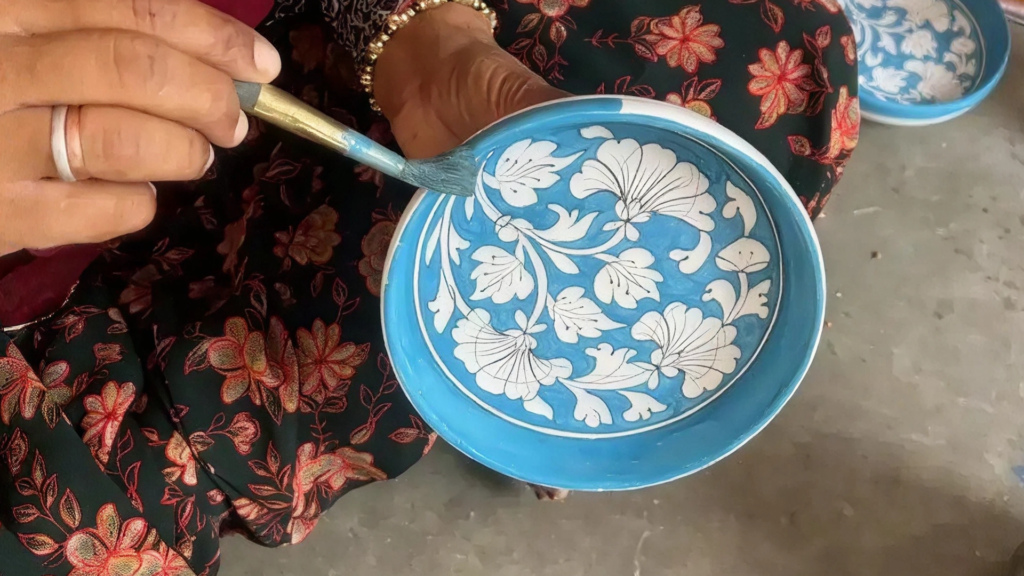
It is not an easy living. Machine-made lookalikes sell for a fraction of the price. Many younger family members are leaving for steadier work, which puts real strain on a craft that only survives by being handed down.
Watching a potter paint a row of petals freehand, with no guideline, no second chance, does more to explain the worth of a piece than any price tag. We point guests who are curious towards the working studios, not the souvenir counters, where the whole process is on show. You meet the makers themselves. There is a real difference between buying an object and understanding one.
Seeing It for Yourself
You can buy a blue bowl in five minutes flat on Amer Road. Seeing how it comes to life takes a little longer, but pays you back for the effort. For anyone staying with us, an afternoon among the potters is one of the simplest things to arrange, one of the most memorable too. Ask us at the front desk, or even before you arrive. We will steer you to the real workshops where the blue pottery of Jaipur is still made the slow way, one cobalt petal at a time.
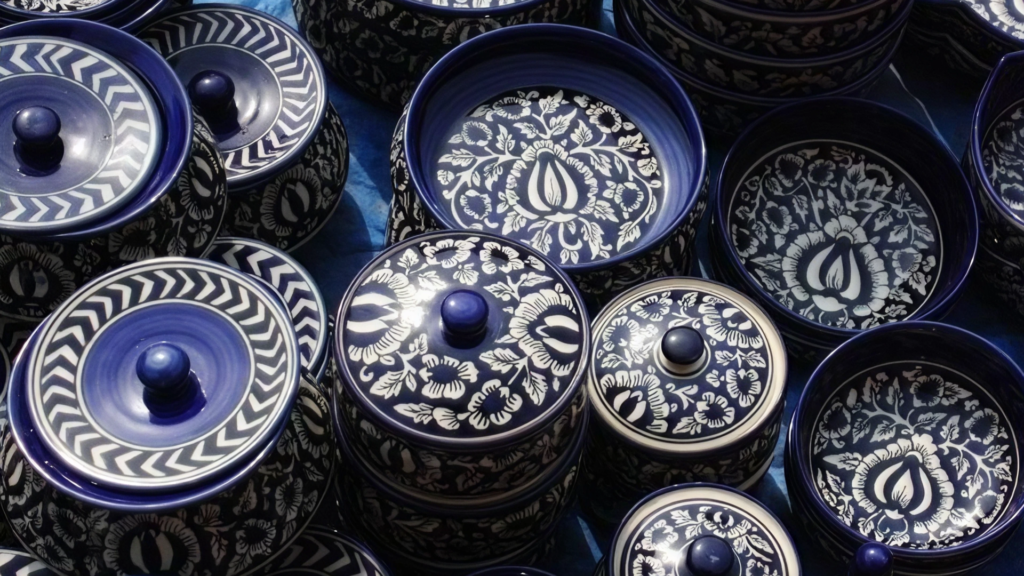
It has outlasted Mughal courts, cheap factories, passing fashions. The least any of us can do is watch it being kept alive. As a family-run heritage haveli in Jaipur, we keep the old crafts close, the potters a short drive from our door, the welcome warm from the moment you step inside. Come stay a while, let us show you the city the way we know it, one blue bowl at a time. Contact us here.
Frequently Asked Questions
Why call it blue pottery when there is no clay, and it comes in green too?
The name stuck from its Persian roots, where cobalt blue on white was the signature look. The body is ground quartz, not clay, and the greens and other shades arrived later, once potters widened the palette.
Can you eat or drink from it?
Most pieces are best kept decorative. It is fired at a low temperature, so it stays porous and brittle, and older or cheaper glazes can contain lead. If you want a bowl for food, ask the maker for a lead-free, food-safe one.
How do you spot a handmade piece from a machine-made copy?
Look for small irregularities in the hand-painting and a light, fragile body that feels almost chalky. A heavy, flawless piece with a pattern identical to its neighbours is usually ordinary ceramic dressed up to look the part.
Where to buy blue pottery in Jaipur?
The honest answer is to go to the source. The working studios sit around Sanganer and the Amer road, where you buy straight from the people who make it, not at the mark-up of a tourist shop. We are happy to point guests the right way, or arrange a visit.
Why does it chip so easily?
Blame the recipe. With almost no clay to bind it and a low kiln temperature, the finished piece is closer to hardened glass paste than sturdy stoneware. Fragility is the price of that glassy finish.
How do you get a piece home in one piece?
Pack it like an egg. Bubble wrap, a rigid box and a spot in your hand luggage give it the best odds, since checked bags are no friend to something this delicate. Many workshops will wrap or ship larger buys for you.
