

A journey to Jaipur is as much about where you stay as what you see. At Dera Mandawa, the suites create an experience that delivers both heritage and comfort. Rather than reproducing history as a display, the heritage suites in Jaipur let guests live within it, surrounded by architecture, textiles, and details that reflect Rajasthan’s way of life.
Rajasthani Traditions Inside the Heritage Suites
Each suite has been designed within the structure of the original haveli. High ceilings, arched openings, and expansive verandas evoke traditional Rajasthani living. Courtyards bring in light during the day and a sense of calm in the evening. These touches in heritage suites don’t feel added on; they sit naturally within the space, giving each suite a distinct personality.
Unlike a standard hotel room, no two suites are the same. Some include private alcoves for reading; others open onto larger shared courtyards. This individuality ensures that every stay carries its own sense of place. Guests are reminded that they are not in a generic setting but in a heritage home that has grown with time.
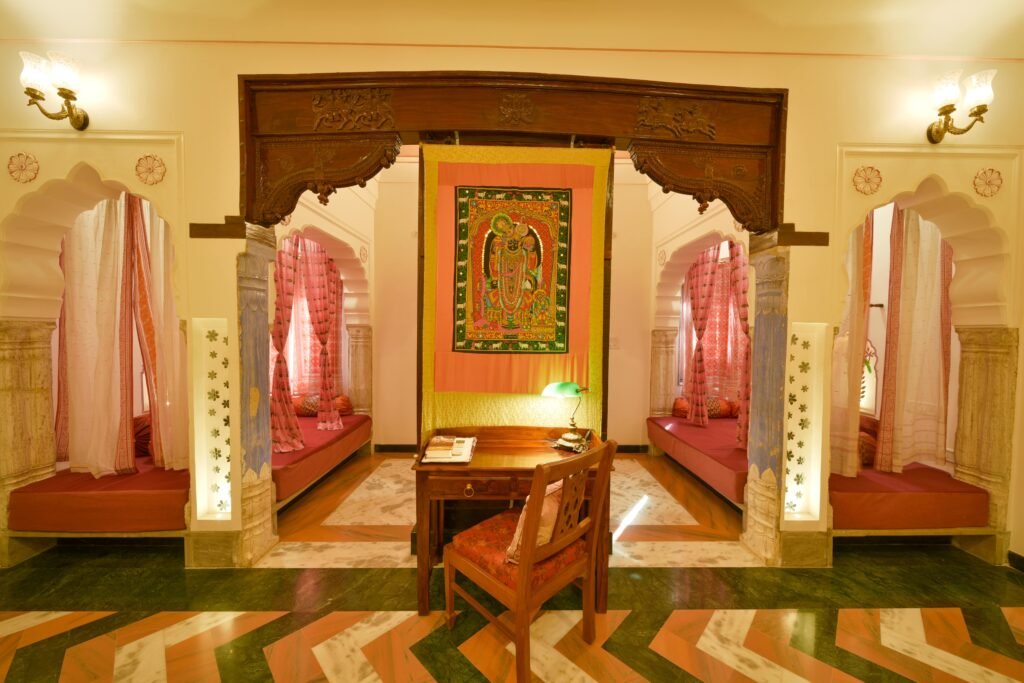
Inside the Suites: Proportion, Light and Air
The dimensions in Dera Mandawa’s heritage suites come from the original building, not a room plan. Ceilings run high enough that hot air collects well above head height, which is why the rooms hold their temperature through a Jaipur afternoon without working hard. Walls are thick lime plaster, arched openings are deep set, and windows are placed to pull a cross draught rather than to frame a view.
Light behaves differently here than in a modern room. Instead of arriving through one glazed wall, it moves across the heritage suites over the course of the day – the araish technique entering low through the verandah in the morning, reflecting off the courtyard floor by afternoon. Jali screens and shuttered openings let you control it without shutting it out entirely. None of this was retrofitted for effect. It is simply how a nineteenth-century heritage haveli was built to work, and it is the reason these heritage suites feel unlike a room designed around air conditioning.
Ease and Elegance Within Historic Walls
A luxury heritage stay in Jaipur is defined not only by atmosphere but by practical convenience. At Dera Mandawa, the suites balance both. Beds are fitted with fine linen, bathrooms feature modern fixtures, and seating areas are arranged to encourage relaxation. The proportions of the original architecture, thick walls, shaded verandas and natural airflow add to the ease of living, especially in the Rajasthani climate.
Hospitality extends beyond furnishings in this Rajasthani suite decor. Guests can enjoy tea in the courtyard, breakfast arrives with local flavours, and staff anticipate needs without intruding. The niceties are understated, keeping the suites’ character central.
What the Heritage Suites Include
Practical details matter as much as atmosphere. Each heritage suite has air conditioning, ceiling fans, hot water, Wi-Fi, and a writing desk or seating area. Beds are king or twin depending on the suite, with fine cotton linen and additional bedding available for children. Bathrooms have been rebuilt for comfort with modern fixtures, while keeping stone and simple fittings rather than gloss and chrome.
Storage is generous, which travellers on longer stays notice quickly. Laundry can be arranged the same day. Tea and coffee arrive on request rather than sitting in a sachet tray, and breakfast can be taken in the courtyard, on the verandah, or in the suite itself. The family arranges airport pickup, guides, and cars, so a heritage stay in Jaipur here involves fewer third parties than a hotel booking usually does.
Choosing Between the Heritage Suites
Because the haveli was never built to a repeating plan, the heritage suites in Jaipur differ meaningfully from one another, and it is worth choosing rather than leaving it to chance.
Courtyard-level suites open directly onto the verandah and the central courtyard. A courtyard suite in Jaipur suits guests who want to step straight out to breakfast, and anyone who would rather avoid stairs. They are the most sociable rooms, since the courtyard is in use throughout the day.
Upper-level suites are quieter and look over the terrace and the rooftops of the old city. These work well for couples, for light sleepers, and for anyone planning early starts to Amer or the bazaars.
Suites with private alcoves suit longer stays, where a separate corner for reading or working makes a difference over a week. Families are usually best placed in adjoining rooms at courtyard level, which the family can arrange if flagged at the time of booking.
Experiencing Jaipur’s Culture Indoors
Staying in the Dera Mandawa suites is also a way of engaging with Jaipur’s culture indoors. Handcrafted décor reflects local traditions, and seasonal flowers arranged in brass vessels echo the practices of family homes. Meals bring regional recipes to the table, continuing stories of taste that belong to the city. For many guests, these quiet details create a memory as lasting as the sights outside.
The suites become a continuation of the city itself. After exploring Jaipur’s forts, markets, and temples, guests return to a setting that still carries the same traditions in its architecture and daily life. This continuity distinguishes a stay here from conventional accommodation.
Rajasthani Craft Inside the Heritage Suites
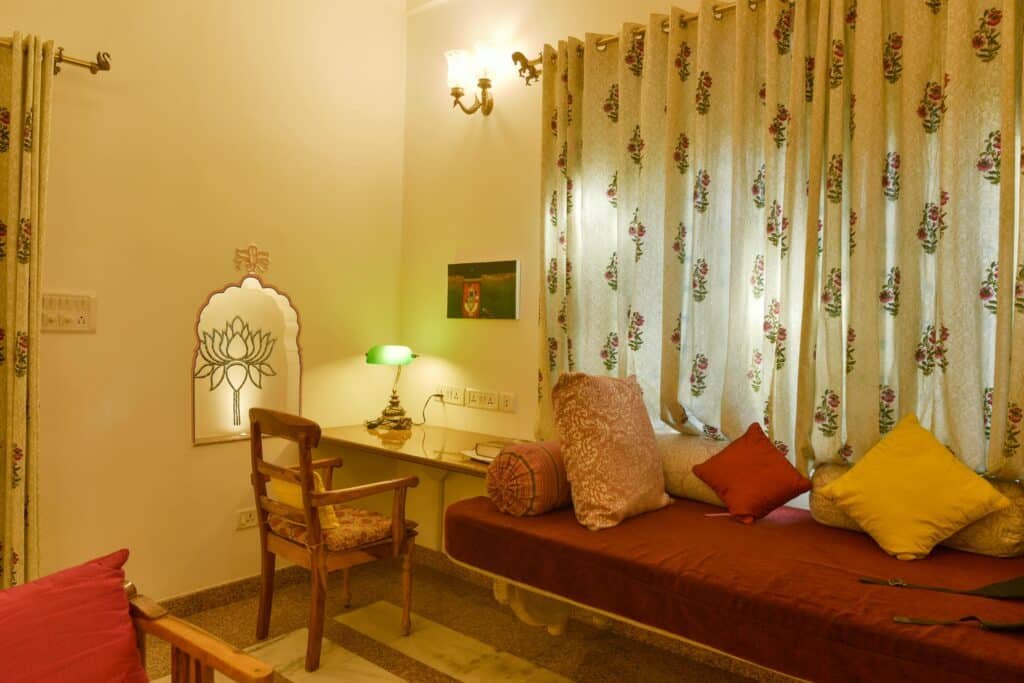
The furnishings are not sourced as decor. Most of what sits in the heritage suites in Jaipur came into the house through use, and the crafts represented are the ones this region has practised for centuries.
Block-printed cottons from Sanganer and Bagru appear in curtains and bedcovers, printed with hand-cut wooden blocks. Tie-dyed bandhani and lehariya, the diagonal wave pattern associated with the Rajasthani monsoon, turn up in cushions and throws. Brass and bidri vessels hold flowers. Hand-painted panels and miniature-style artwork follow conventions developed in Rajasthani court workshops, where pigment was ground from minerals and the finest brushes were made from squirrel hair.
Frescoes on the older walls use the araish technique – lime plaster burnished with agate until it takes a sheen. This is a Shekhawati speciality and why Rajasthani havelis hold their colour the way they do.
The City’s Culture Beyond the Heritage Suites in Jaipur
Chandpole Gate is a short walk from the door, and past it the walled city opens up. Jaipur’s culture is easiest to meet on foot here – in the lac bangle workshops of Tripolia Bazaar, the jewellers of Johari Bazaar, and the flower market that finishes trading before most visitors have had breakfast.
Hawa Mahal, the City Palace and Jantar Mantar all sit within two kilometres. Amer Fort, Nahargarh and Jal Mahal are a short drive north. What a haveli offers that a hotel on the ring road cannot is the ability to walk out into that fabric and back again in an hour, which changes how much of Jaipur’s culture you actually absorb over three or four days.
Living heritage with ease
For those seeking a luxury heritage stay in Jaipur, Dera Mandawa offers a setting that feels both personal and memorable. The suites are not themed replicas, but living spaces that preserve the haveli’s character. Practical details matter as much as atmosphere. Every one of these haveli suites in Jaipur has air conditioning, ceiling fans, hot water, Wi-Fi, and a writing desk or seating area.
Choosing the Dera Mandawa suites means experiencing Jaipur city as a guest in a heritage home rather than as a passerby. Each detail has been thoughtfully crafted for convenience, and every space carries the essence of Rajasthan. Hospitality is shared with genuine care.
We look forward to welcoming you to our haveli and sharing our way of life in Jaipur.
Frequently Asked Questions
What is special about staying in Dera Mandawa’s suites?
Each suite at Dera Mandawa reflects Rajasthani heritage with traditional décor, handcrafted furnishings, and spacious layouts that blend authenticity with modern comfort.
How do the suites reflect the Rajasthani way of life?
The suites are designed to showcase Rajasthani culture through vibrant textiles, local artwork, and architectural details that celebrate Jaipur’s royal traditions.
Are the suites at Dera Mandawa equipped with modern amenities?
Yes, while preserving heritage charm, the suites offer modern facilities such as air conditioning, Wi-Fi, and comfortable bedding to ensure a relaxed stay.
Can guests experience Rajasthani hospitality at Dera Mandawa?
Absolutely. Guests are welcomed with warmth and can enjoy personalised service, traditional dining, and cultural activities that represent genuine Rajasthani hospitality.
Is Dera Mandawa suitable for families and groups?
Yes, the spacious suites and homely atmosphere make Dera Mandawa an ideal destination for families, couples, and groups seeking a heritage experience in Jaipur.
What cultural experiences complement a stay at Dera Mandawa?
Guests can participate in cooking classes, folk music sessions, kite-flying, and guided walks, all carefully curated to deepen their understanding of Jaipur’s traditions.
How does staying at Dera Mandawa differ from a modern hotel in Jaipur?
Unlike a regular hotel, Dera Mandawa offers a personalised and cultural stay where history, heritage, and hospitality come together to create a unique experience.
When is the best time to stay at Dera Mandawa in Jaipur?
The best time is from October to March, when the weather is pleasant for exploring the Pink City and enjoying the outdoor spaces of the heritage property.
Are the heritage suites suitable for long stays?
Yes, and a number of guests stay a week or more. Storage, same-day laundry, desk space and flexible meal timings all make an extended heritage stay in Jaipur workable, and longer stays can usually be discussed on rate.
