

Turn over a fine piece of Jaipur jewellery. You find a small act of generosity. The front dazzles with gemstones, as you would expect. The back, the side no one but the wearer will ever see, is painted with tiny enamelled flowers and birds, every bit as careful as the front. Two crafts, two artists, one ornament, half of it built to stay hidden against the skin. This is where kundan and meenakari come together, the reason the Pink City has dressed royalty, brides, even the odd visiting film star, for four hundred years.
So what is kundan, what is meenakari, and why did this one place become their home? The short version involves craft, patience, and a couple of very determined kings.
So What Is Kundan
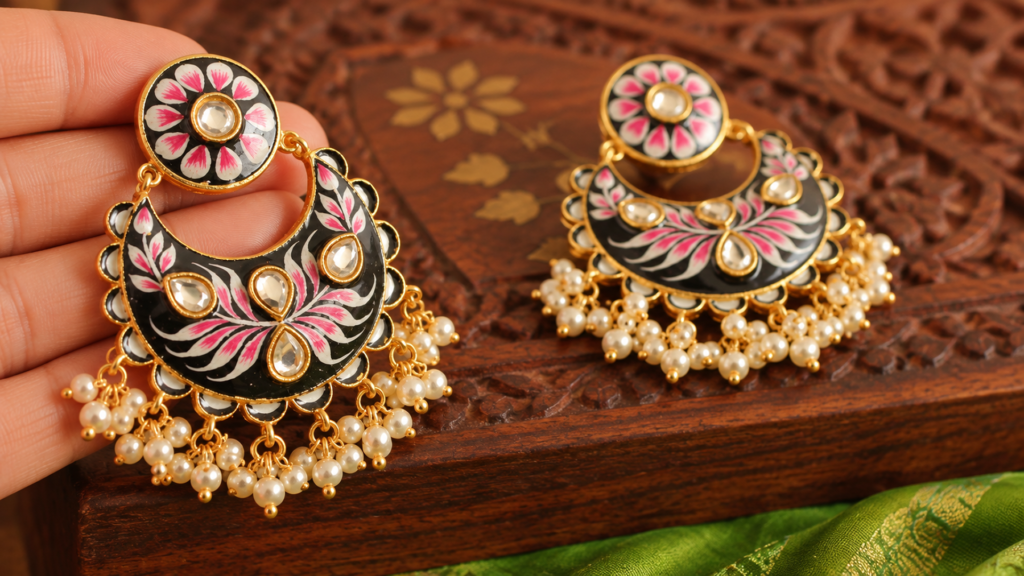
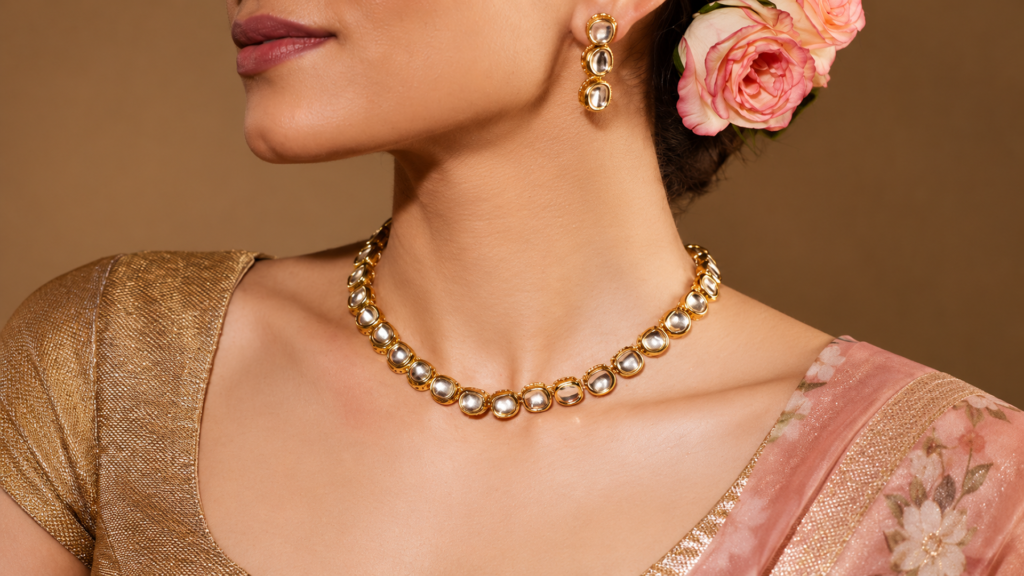
The word kundan means purified gold, the softest, most workable gold there is, handled at nothing hotter than room temperature. Here is the clever part. Where a Western jeweller grips a diamond with metal claws, a kundan setter uses none at all. Each stone rests in a bed of lac, a natural resin, held in place by slivers of pure gold foil pressed around its edge by hand. The base of a piece is usually twenty-two-karat gold, while the foil that grips each stone is a softer, purer twenty-four. The metal is soft enough to mould to a stone like putty, so the finished gem seems to float with no visible support.
The stones themselves are usually left much as nature left them, barely cut, rubies, emeralds, sapphires, pearls. When they are uncut diamonds, the same craft goes by another name: polki, the version grandmothers speak of in hushed, reverent tones. The method is ancient, born in the royal courts long before the city itself existed, a craft that rewards patience above all else. A single necklace can pass through a dozen pairs of hands, taking weeks to complete.
And What Is Meenakari
If kundan is about stones, meenakari is about colour. The name comes from a Persian word for heaven. The craft does live up to it. Picture the enamelled eggs of Fabergé, or the jewel colours of a stained glass window shrunk to the size of a fingernail. The enameller cuts fine grooves into the metal, fills them with powdered coloured glass, then fires the piece so the powder melts into a glossy, permanent colour. Each shade is fired on its own, in order of how much heat it can bear, with the fragile red saved for last.
Every region that took up the craft gave it a private accent, Banaras a dusky pink, Lucknow a cooler blue-green, while Rajasthan’s capital city kept its bold red, green, white on gold. Its artisans grew famous for a rarer skill still, laying transparent enamel over gold so the metal glows through from beneath. Make no mistake, this is not paint. It is glass, fused to metal by fire, which is why a good piece holds its colour for a century, yet a careless knock will chip it. Real meenakari art hides nothing, forgives little. The same enamel brightens more than jewellery, turning up on boxes, bowls, even ceremonial dagger hilts.
How One City Came to Own Both
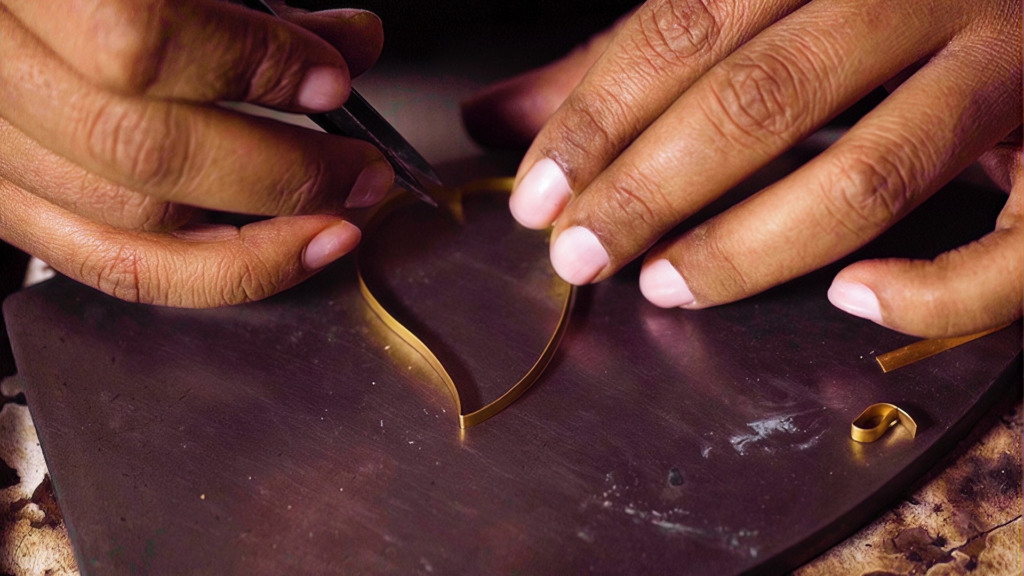
Neither craft was invented here, yet this became their capital. Kundan grew up in the Rajput and Gujarati courts, polished to brilliance under the Mughals, who had a sharp eye for luxury. Enamelling arrived by a more specific route. In the late sixteenth century, Raja Man Singh of Amer, a general in the Mughal army, was so taken with the enamel work he saw in Lahore that he brought a handful of its master craftsmen home to settle near his fort at Amer, just outside modern Jaipur. Their workshops soon took root. When Sawai Jai Singh the Second laid out his brand-new planned city in 1727, he made a point of drawing artists into it.
The jewellers gathered in a lane still called Johari Bazaar, the jewellers’ market, where much of the trade sits today. There is a pleasing footnote for European readers, too. Some of the finest glass for the enamel was imported from Europe, carried east along the old trade routes. The jewellery of Rajasthan, it turns out, was always a conversation between worlds.
The Ornament With a Secret Back
Here is where the two crafts become one. In the Jaipur style, a single piece carries kundan stones on the front, meenakari enamel on the back, finished on both faces. The wearer keeps a private second artwork, glimpsed only when a necklace turns or an earring swings. It is a discreet kind of showing off, beauty spent on a surface almost nobody will admire, a small boast about the pride of the people who make it. In a fine bridal piece, the enamelled reverse is judged as carefully as the stones on the front.
One piece may pass through the hands of a designer, a goldsmith, a stone-setter, an engraver, an enameller, a polisher, each a master of a single step. Small wonder a good bridal set is kept as an heirloom, handed down through families, worn at weddings for generations. The hidden back is the better half.
How to Spot the Real Thing
Since you will meet a great deal of it here, a word on telling real meenakari art from cheap costume. Turn the piece over first. Genuine work shows finished enamel on the reverse, not bare or glued metal. The setting around each stone should look smooth, continuous, coaxed by hand, not a blob of adhesive pinning a gem into a cast. Weight is a clue as well, since real pieces carry the heft of solid metal. Good enamel sits flush, glassy, never raised or patchy. None of this is about spending a fortune. Plenty of modest pieces are made the proper way.
It is simply about knowing that the jewellery of Rajasthan, at its best, is a made thing, not a moulded one.
Come and See It for Yourself
If any of this makes you want to see it up close, that is rather the point. We are a family-run heritage haveli in Jaipur, a short walk from the jewellers’ lanes of the old city. Few things please us more than steering a curious guest towards the workshops where kundan and meenakari are still made by hand, well clear of the tourist counters. So if you are weighing where to stay in Jaipur, come stay with us, turn a few pieces over, decide which side you like better.
Write to us for dates. We will gladly help with the rest.
Frequently Asked Questions
What is the difference between kundan and meenakari?
Kundan is the stone-setting on the front of a piece, with gems held in pure gold foil without prongs. Meenakari is the coloured enamel work on the back. They are two separate crafts, done by different artisans, combined on one ornament in the Jaipur style.
Is kundan real gold?
Yes. Kundan is the pure 24-karat gold foil used to set the stones, and the base is usually 22-karat gold. The word itself means purified gold. Cheaper “kundan-style” fashion pieces, though, only imitate the look in base metal.
What is the difference between kundan and polki?
The technique is the same, only the stone changes. Kundan uses coloured gemstones or glass set in gold foil. Polki uses uncut natural diamonds set the same way. Polki is usually the pricier of the two, because those raw diamonds are the real thing.
Why is meenakari done on the back of the jewellery?
In the Jaipur style, the enamelled back becomes a second, hidden artwork seen only by the wearer. It also finishes and protects the metal, and on a fine bridal piece the reverse is judged as carefully as the stones on the front.
Which city is famous for kundan and meenakari?
Jaipur has been the centre of both crafts since the late sixteenth century, when enamellists were brought from Lahore. Its signature is meenakari in red, green and white on gold, paired with kundan stone-setting on the front.
Can meenakari enamel chip, and can it be fixed?
Yes, it can chip, since the enamel is essentially glass fused to metal, so a hard knock may crack it. A skilled enameller can sometimes re-fire and restore a damaged patch, though it is delicate work.
