

If I had to explain Jaipur to someone, I would not start with a monument. I would start with a day. A specific kind of day where nothing is scheduled too tightly, where lunch runs late, where music starts without an announcement, and where people arrive in groups rather than alone. That is where the city makes sense to me, not in checklists, but in lived moments influenced by Rajasthani culture, present without trying to be special.
Yes, Jaipur has landmarks that people travel across continents to see. Hawa Mahal is striking. City Palace, Jaipur, is commanding. The forts in Jaipur are dramatic in the way history tends to be. But those places are the frame, not the picture. The picture is everything that happens around them, before and after, quietly but consistently.
The Jaipur that never makes it into guidebooks
Some of the most memorable Jaipur cultural experiences happen in the most ordinary settings. Courtyards get busy with preparation rather than decoration. Conversations around the neighbourhood overlap. Someone singing while working, not because anyone asked them to. That is how things begin here.
During Gangaur, for example, the part people usually photograph is the procession. My favourite part is the afternoon before. Flowers spread out on the floor. Bangles clinking softly as hands move. A familiar song starting halfway through a sentence, then being picked up by others. By evening, traditional Rajasthani music takes over the space naturally, with instruments appearing because they always do on days like this.
No one stops to explain what is happening. You recognise it because you have seen it before.
Art that belongs to the house, not the wall
In Jaipur, Rajasthani folk art does not sit politely waiting to be admired. It lives on surfaces that are used and looked at every day. Walls get repainted because the season has changed. Familiar motifs return because they are meant to. This is not preservation. It is continuation.
Seeing this kind of work regularly removes any urge to romanticise it. The work is valued, but not precious. It can be refreshed, adjusted, or redone. That flexibility is exactly why it survives. It stays relevant because it stays close to daily life. This approach says a lot about the traditional culture of Rajasthan. Nothing is frozen. Everything is carried forward through use.
Rajasthani culture and traditions as daily life, not a display
What defines Jaipur is not spectacle, but repetition. Certain festivals arrive every year and look much the same. Certain foods appear only on specific days. Ghewar does not show up randomly. You wait for it. When it arrives, you know precisely why it is there.
This is what Jaipur cultural experiences look like from the inside. Not novelty, but familiarity. People return to the same customs because they work. Celebrations are collective rather than curated. People prepare food in quantity and share it without fuss. Dancer Rukmini Devi Arundale wrote a line that feels apt here: “Culture is something which is lived, not learnt.” This city never tries to teach you anything. It simply continues.
Sound that gathers people
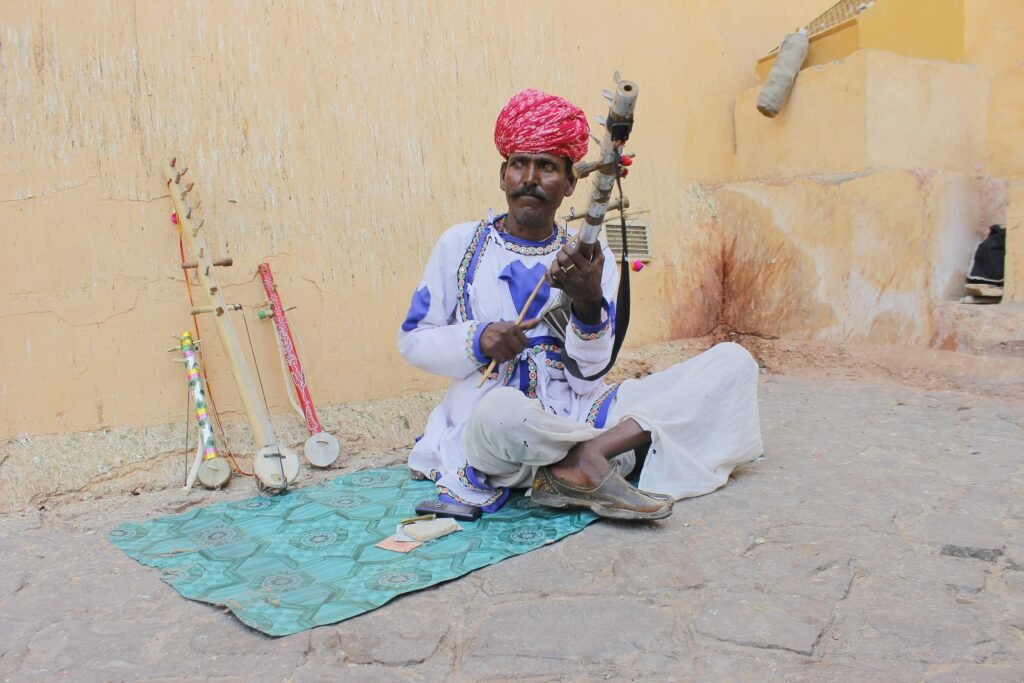
Music plays a particular role in Rajasthani culture. Traditional Rajasthani music appears when it needs to, not because it has been scheduled. At weddings, festivals, and family gatherings, songs start casually and then grow louder as more voices join in. The sound is confident, familiar, and unpolished in the best way.
There is no separation between performer and audience. Everyone present becomes part of it. This is not entertainment; it is participation. That is why it feels so different from staged performances meant to impress.
Why landmarks fade, but moments stay
I don’t measure my relationship with Jaipur by the places I have visited. I measure it through moments that repeat. Through days that look almost identical year after year and still feel significant. This is where the traditional culture of Rajasthan shows its strength. It does not need reinvention to stay relevant.
Landmarks remain impressive, but they are static. Life here is not. The city’s energy comes from people gathering, food arriving in rounds, music beginning halfway through conversations, and art being refreshed because the time feels right.
These details are easy to miss if you are busy sightseeing. They become apparent if you are paying attention to how the city moves.
What makes Jaipur feel personal
There is a certain enthusiasm in Jaipur that I admire profoundly. It does not chase approval. It does not adjust itself for outsiders. It carries on doing what it has always done, trusting that those who notice will stay, and those who do not will move on.
This is why my favourite Jaipur memories have nothing to do with sightseeing. They are rooted in Rajasthani culture that continues without explanation or performance.
You can photograph a palace, but you cannot photograph the feeling of a song starting naturally, or a festival afternoon stretching longer than expected, or art being repainted because the season has turned. Those moments live only with you.
And that is exactly why they matter more.
If you are curious about this side of Jaipur, the one shaped by daily life, familiar traditions, and long-established ways of hosting, you are welcome to experience it with us. Dera Mandawa has always been a home first and a heritage haveli in Jaipur second. Stay for a night or a few days, join us for meals and conversations, and take the city in at your own pace, without trying to collect it.
For reservations or enquiries, please contact us here. We would be happy to hear from you.
Frequently Asked Questions
What is Rajasthani culture known for?
Festivals tied to the lunar calendar, food that changes with the season, music that everyone present is expected to join, and folk art painted straight onto the walls of homes. What ties them together is that none of it is staged. In Jaipur, Rajasthani culture is something people do on the same days every year, not something they put on for visitors.
Which Rajasthani culture and traditions can a visitor actually see in Jaipur?
The calendar does the work. Makar Sankranti in January fills every rooftop with kites. Gangaur in March or April brings a procession out of the City Palace through Tripolia Gate. Teej in the monsoon sends a second procession down the same route, with ghewar on every table. Diwali turns the bazaars into a lighting competition. All of these are public, none are ticketed, and the afternoon before each one is usually better than the event itself.
When is Gangaur celebrated in Jaipur?
It begins the day after Holi and runs for eighteen days, ending in late March or April with the procession. Dates shift with the lunar calendar, so check the year you are travelling. The procession leaves the City Palace through Tripolia Gate in the late afternoon and is free to watch from the street. The preparation in courtyards and homes over the days before is the part most visitors never see.
What is ghewar, and why do you have to wait for it?
A disc of fried batter with a honeycomb texture, soaked in sugar syrup and sometimes topped with cream or nuts. It belongs to the monsoon and is made for Teej and Raksha Bandhan, roughly July and August. Most sweet shops in Jaipur only make it in season, which is exactly the point: the calendar tells you what to eat.
What Jaipur cultural experiences can a visitor take part in rather than just watch?
More than most cities allow. Kite flying on Makar Sankranti is open to anyone with a rooftop and a spool. Gangaur and Teej processions are watched from the street with everyone else. A saree or safa tying session, a cooking session in a family kitchen, or a folk evening in a courtyard are all easy to arrange. The best Jaipur cultural experiences are the ones where you are a participant rather than the audience.
Is the traditional culture of Rajasthan still lived, or mostly staged for tourists?
Both exist, and they are easy to tell apart. Staged culture is scheduled, ticketed and repeated nightly. The traditional culture of Rajasthan described here is tied to the calendar, happens whether or not anyone is watching, and starts without an announcement. A hotel folk show is not fake, but it is Rajasthani culture at one remove. A Gangaur afternoon in a neighbourhood courtyard is the thing itself.
What is Rajasthani folk music like at a family gathering?
Participatory rather than performed. Someone starts a song, others pick it up, and a dhol or harmonium appears because it always does. The songs are seasonal and devotional, everyone present is expected to join, and nobody minds a wrong note. It sounds unpolished next to a concert, and that is what makes it work.
Why do people in Jaipur repaint their houses for festivals?
Because the art is meant to be renewed, not preserved. Before Diwali and before a wedding, the house is cleaned and repainted and the motifs around the doorway are redrawn, often by the family rather than an artist. Painting over last year’s work is not a loss. It is how the tradition stays alive, and it is the difference between folk art on a house and folk art in a museum.
What is the best time of year to experience Rajasthani culture in Jaipur?
October to March for the weather, and the festivals where Rajasthani culture is most visible fall conveniently inside it: Diwali in October or November, Makar Sankranti around 14 January, Gangaur in March or April. Teej in July or August is the one exception worth braving the monsoon for. Pick a festival first and plan the dates around it; the winter festival calendar has the confirmed dates.
Can guests at Dera Mandawa take part in Rajasthani culture as it is described here?
Yes, because the house is lived in. Meals come from the family kitchen, festivals that fall during a stay are marked in the courtyard rather than a lobby, and the family is present rather than a front desk. If a particular festival matters to you, say so when you enquire and we will tell you honestly whether the dates work.
