

Rain is a difficult thing to paint. So is longing, or the smell of the first shower on hot earth, or the particular restlessness that a grey sky brings on. For roughly three hundred years, the court painters of Rajasthan set themselves exactly this task, and the result is some of the most evocative seasonal art India has produced. Rajasthani miniature painting turned the arrival of the monsoon into a subject in its own right, capturing not only the clouds and the peacocks but the emotions the rains stirred in the people beneath them.
To understand this small, jewel-like art is to understand something central to Rajasthan art and culture. These were courtly works, commissioned by the Rajput rulers of kingdoms such as Mewar, Bundi, Kota, Kishangarh and Jaipur between the 16th and 19th centuries, and painted by master artists on paper no larger than a book page. The monsoon imagery they used carried well beyond the court, echoing through Rajasthani folk art for generations afterwards. Many of the finest painters had trained in or near the Mughal imperial studios before finding patronage at these desert courts.
Why the Monsoon mattered in Rajasthani Miniature Painting
In a largely dry land, the coming of the rains was the most charged moment of the year. It meant survival, since the crops depended on it, and it meant romance, because the season carried a long association with love, reunion and, above all, separation. A husband away on business or at war would ideally be home before the rains arrived. The wife left waiting became one of the great subjects of Indian art, the lovesick woman watching the storm clouds gather while her beloved stayed away. Painters found in the monsoon a way to make an inner feeling visible through an outer landscape.
Two great painting genres carried this theme, and both were adapted with real brilliance by Rajasthani artists.
Ragamala, Painting the Sound of Rain
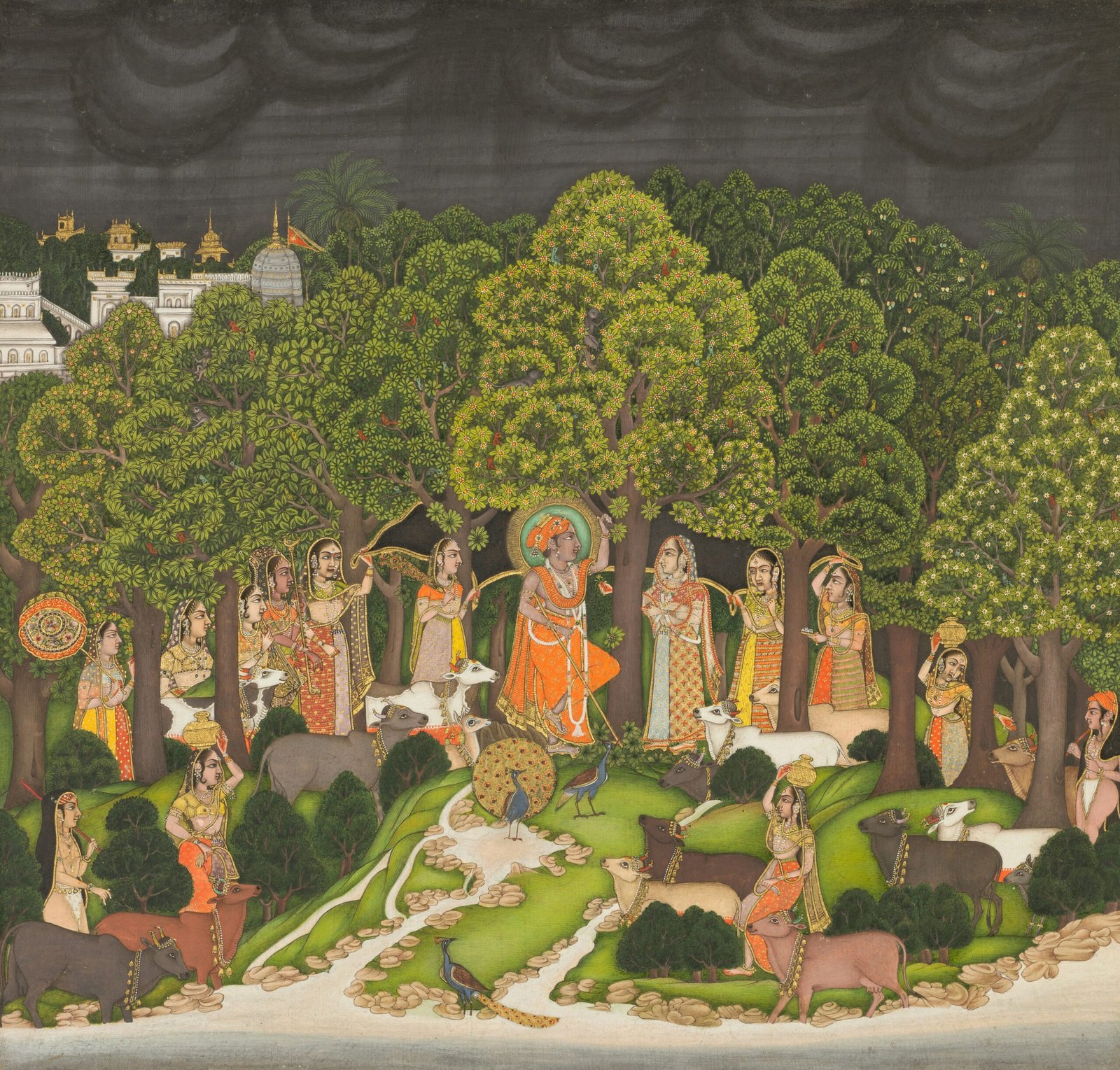
The first was the Ragamala, meaning garland of ragas. The idea was to translate music into an image. Each raga, a melodic mode in Indian classical music, was given a scene, a mood, a season and a time of day, so that a viewer could, in a sense, see the music. The monsoon belonged to Raga Megha, the rain melody. Megha means cloud, and the raga is one of the six principal ragas of the tradition.
In a Ragamala painting of this raga, the artist would show a youthful figure, sometimes the god Krishna with his blue skin, dancing or sounding a conch, surrounded by women, while heavy dark clouds gather overhead. The whole picture is tuned to the joy of the first rain. It stands as the visual echo of a melody sung only in the monsoon, and a fine example of how completely these painters married sound, feeling and season on a single page.
Barahmasa, The Twelve Months of love
The second genre was the Barahmasa, or twelve months, which took the viewer through the year one month at a time, tracing the changing moods of a pair of lovers as the seasons turned. Much of it drew on the verses of the poet Keshavdas, whose descriptions of each month were so exact that painters could lift them almost directly onto the page.
The monsoon months of Shravan, roughly July to August, and Bhadon, August to September, were the emotional high point of the whole series. Here, the artist would paint the pining heroine, the nayika, alone on a balcony or terrace as the rain breaks, caught between the beauty of the season and the ache of her absent love. Indian poetry calls that state viraha, the pain of separation. Sometimes the mood turns, and the startled heroine is shown clinging to her returned lover as the thunder rolls.
A Vocabulary of Clouds and Peacocks
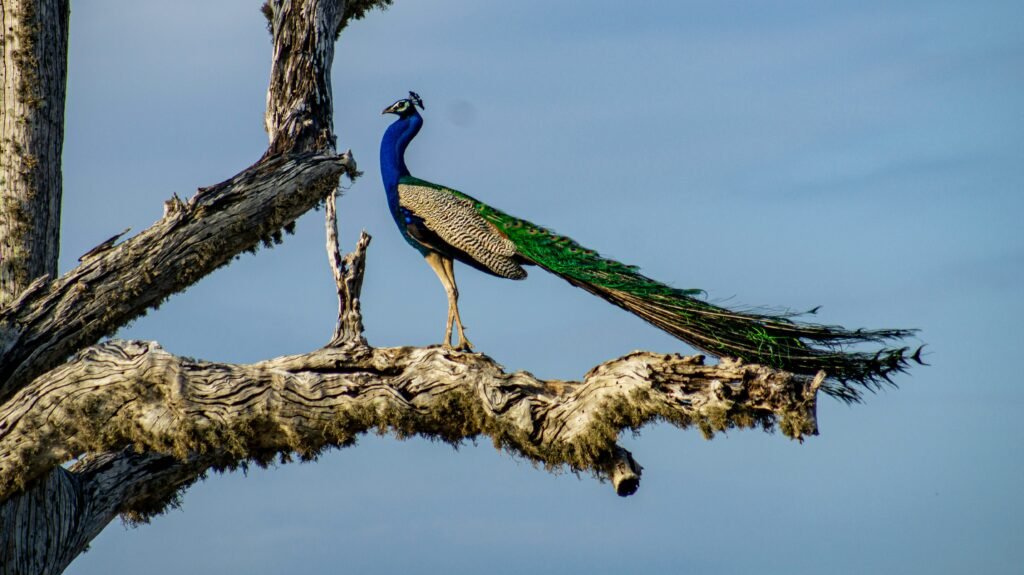
What makes these monsoon paintings so recognisable is a shared visual language, some of it set down as far back as the Chitrasutra, an ancient Indian treatise on painting. The rainy season is signalled by banks of dark, thundering cloud, by streaks of lightning picked out in gold, and by creatures that belong to the rains. Peacocks dance with their tails spread wide. Rows of white cranes fly in formation across the black sky.
A lone cuckoo calls from the leaves, lakes fill with lotus, and the whole land turns green. Every one of these details carries meaning, and the dancing peacock and the flying cranes stand in for lovers and for the wish to be reunited.
Made on a Book page, in Stone-Ground Colour
The craft behind the image was remarkable. Painters worked on wasli, a sheet built up from layers of handmade paper, using opaque watercolours ground from minerals and semi-precious stones, lapis lazuli for deep blue and malachite for green, with fine details raised in real gold and silver. The most delicate lines were laid down with brushes made from a few hairs of a squirrel’s tail. A single painting could take weeks to finish.
This art did not only live on paper. The same painters decorated the walls of palaces and havelis with the very same scenes, and some of the great painted rooms of Rajasthan, such as the Chitrashala at Bundi, survive to this day.
To stay in an old frescoed haveli is to see the tradition in its original home.
At Dera Mandawa, our family residence in the heart of Jaipur, whose walls carry the frescoes and carved detail of a bygone era, guests wake among the kind of painted heritage these court artists made, a living thread of Rajasthani miniature traditions.
Looking Again at the Rains
Next time the monsoon breaks, it is worth remembering that generations of Rajasthani painters spent their lives learning to capture this precise moment, the darkening sky, the dancing peacock, the heart made restless by rain. Their tiny, glowing works, now held in museums from London to Los Angeles, remain among the most tender records of how a whole culture felt about the coming of the rains.
To experience Jaipur’s living art and heritage first-hand, contact us to book your stay at Dera Mandawa.
