

Dera Mandawa, a heritage haveli, sits just inside Jaipur’s old city, behind a solid red sandstone gate that opens into a quiet courtyard. It is not styled as a hotel; it has always been a home. The structure, proportions, and materials remain as they were when Thakur Durga Singhji’s ancestors built it, and have been maintained as one of Jaipur’s top heritage hotels with the same care over the years. For travellers seeking a top heritage haveli, this is a place where history is lived, not displayed.
The family still lives here, and guests are welcomed into spaces used daily for decades. This ongoing relationship between host, guest, and place is at the heart of what makes Dera Mandawa a distinctive heritage stay in Jaipur.
What defines a 19th-century heritage haveli
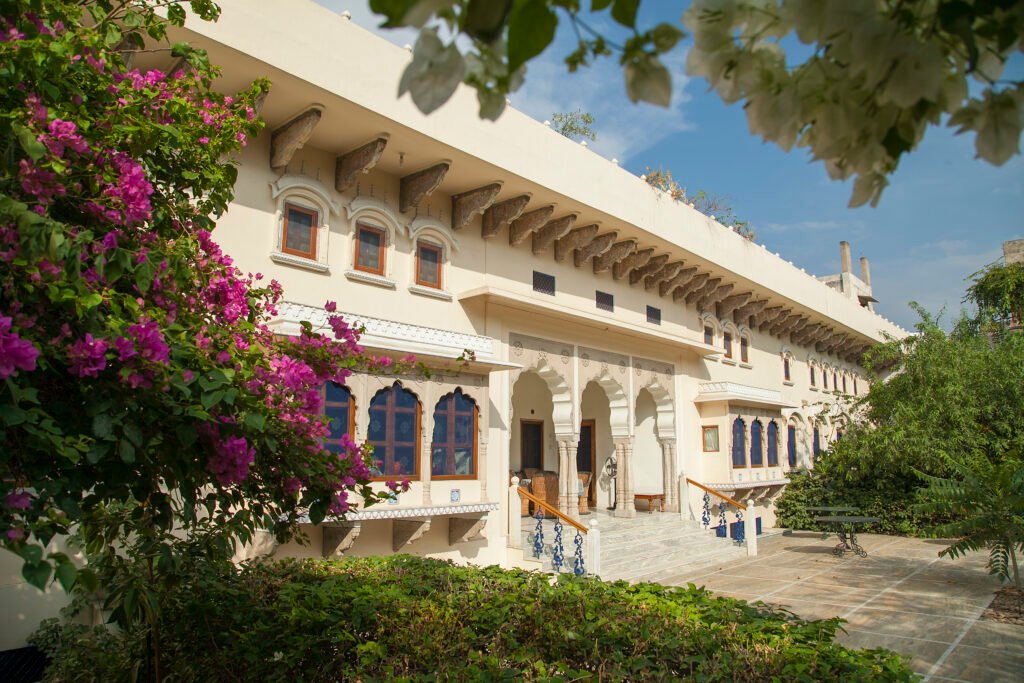
Built in the late nineteenth century, the house follows the logic of a courtyard mansion rather than a modern floor plan. Rooms open inward instead of outward, corridors run along shaded verandahs, and the thick lime-plastered walls hold off the heat of a Jaipur afternoon well enough that most spaces stay cool on their own. Jharokha windows, carved stone brackets, and deep-set door frames were built for climate first and ornament second.
That construction logic is also why a heritage haveli feels different to live in than a hotel built from a template. Sound carries across an open courtyard. Light shifts through the day instead of arriving from a single window. Very little of this was recovered through a restoration project; the house simply kept being lived in, and repairs were made in the original materials as and when needed.
Heritage Haveli Architecture in Jaipur: What to Look For
Once you know the vocabulary, a traditional haveli in Jaipur that visitors walk past every day becomes readable. Six features define the form.
The chowk, or central courtyard, is the organising element. Everything faces inward onto it, which is why heritage haveli architecture in Jaipur produces buildings that feel private from the street and open once you are through the gate.
Jharokhas are the projecting enclosed balconies with carved stone screens. They let women in the household see the street without being seen, and they shade the wall below them.
Jali screens are the pierced stone lattices. They cut glare, force air through a narrow opening so it accelerates and cools, and throw the shifting patterns you see across the floors here throughout the day.
Chhajja are projecting drip stones above openings that throw rain clear of the wall.
Araish is the lime plaster finish, burnished with agate until it takes a sheen, which is why old surfaces hold their colour.
Sandstone and lime, not cement. The walls breathe, which is the reason a heritage haveli stays cool without help.
Rooms that prioritise space and ease
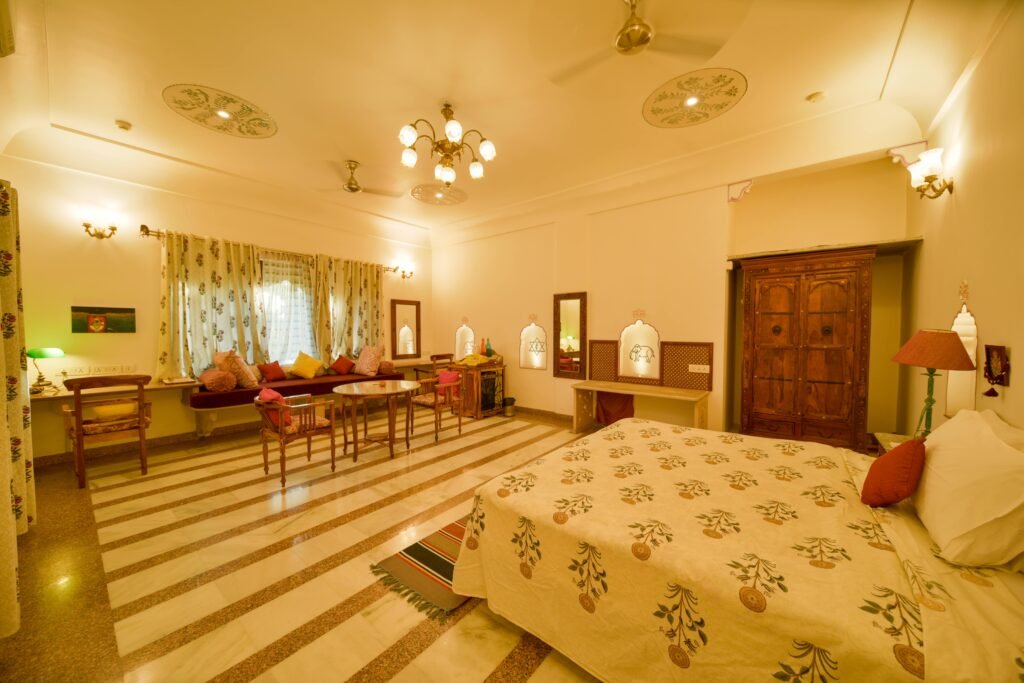
Each suite is individually arranged around the heritage haveli’s central courtyard and verandahs. High ceilings, original floors, and a mix of Rajasthani and colonial furniture keep the spaces true to their heritage. Rooms are functional and quiet, with large beds, quality linen, generous storage, and warm, understated lighting.
Bathrooms have been updated for comfort while staying true to the heritage haveli’s character. The fittings are simple, the lighting soft, and the space feels like a natural continuation of the room rather than a modern addition.
Here, rooms are not themed or staged; they are simply maintained and adapted for use. For those looking for a suite in Jaipur that balances comfort with heritage without unnecessary design, Dera Mandawa’s accommodation is well suited.
Suite sizes vary because the house was never built to a repeating plan. Some rooms sit at courtyard level with direct access to the verandah; others are a floor above, looking over the terrace and the rooftops of the old city. Air conditioning, ceiling fans, Wi-Fi, and hot water are all in place, fitted discreetly. Guests choosing a heritage stay in Jaipur over a conventional hotel usually want exactly this: modern function without modern surfaces.
Food served from the family kitchen at the heritage haveli
Meals come from the same kitchen the family uses every day. The food isn’t elaborate or theatrically presented; it is seasonal, clean, and rooted in home recipes. Vegetables, grains, and fresh ingredients are central. Breakfast might include fruit, eggs, fresh breads, and local dishes on request. Lunch and dinner are planned in advance, often discussed with guests over tea.
No menu card or fine-dining ritual. Service is quiet and unhurried, contrasting with the more structured approach found in restaurants and hotels elsewhere in the city.
A courtyard that remains in use throughout the day
The central courtyard is the house’s centre. Breakfast is usually served here; in the evenings, there is tea, conversation, or quiet reading. Seats sit in the shade, plants sit in weathered planters, and small lamps light at dusk. It is not styled for show but is simply the heart of the house.
Other shared spaces include a reading area, a sitting room with board games, and hallways lined with artefacts from the family’s travels. None of these is curated displays; they are part of daily life and open for guests to use.
Stepping out of the heritage haveli into the old city
Location is one practical reason travellers choose this heritage haveli. Chandpole Gate is a short walk away, and past it the grid of the old walled city opens up: Tripolia Bazaar for lac bangles and brassware, Johari Bazaar for jewellery, and a flower market that starts before dawn. Hawa Mahal, the City Palace, and Jantar Mantar all sit within two kilometres.
Amer Fort, Nahargarh, and Jal Mahal are a short drive north. Because the family knows the city rather than a printed list of sights, timings tend to be suggested in a sensible order: the fort early, the bazaars late afternoon, the terrace at sunset. You can arrange cars and guides on request, without a package attached.
Interactions that are informal and direct in a heritage haveli
A defining feature of a stay here is the chance to meet and speak with the family. Thakur Durga Singh is often present, and conversations happen naturally over meals, during walks, or when guests return from sightseeing. There are no staged heritage walks or formal cultural sessions, only local knowledge shared in context.
The staff are attentive without formality. They offer tea and water before you ask. Children are included without fuss. No one upsells or pressures you to follow an itinerary. This makes Dera Mandawa a rare thing among heritage properties in Jaipur – not a museum piece by definition, but a place where hospitality is led by people rather than process.
A home that continues without reinvention
Dera Mandawa is not a boutique hotel created for effect. It is a home that has adapted over time without losing its function or identity. Changes are made only when needed, and not to follow design trends.
Many guests arrive through personal recommendations. Some return with family, and others stay longer than they planned. Among Rajasthan’s heritage properties, what sets this top heritage haveli apart isn’t elaborate styling, but the ease of entering a living home and becoming part of its rhythm.
Rooms here are limited, and the October to March window fills early. Dates, room configurations, and meal arrangements are easiest to settle directly with the family, so keep that in mind when comparing properties that book through third parties.
Frequently Asked Questions
What is a heritage haveli?
A heritage haveli is a traditional Indian mansion, usually built around one or more courtyards by a noble, merchant, or royal family, with carved facades and materials suited to the desert climate. It is not a museum piece by definition – Hawa Mahal and City Palaceas paid accommodation many surviving havelis in Rajasthan, including Dera Mandawa, have opened as heritage hotels while remaining private homes, which is what separates a heritage haveli stay from a standard hotel room.
What’s the difference between a heritage haveli and a heritage hotel?
A haveli describes the building itself: a historic courtyard mansion with a specific architectural lineage. A heritage hotel refers to how a building is used today – as paid accommodation – and it doesn’t have to be a haveli; some heritage hotels in Jaipur are converted forts or garden bungalows instead. Dera Mandawa is both at once: an original family haveli that also operates as a heritage hotel, with the family still living in it.
Is Dera Mandawa a hotel, or is it still a private family home?
Both. Dera Mandawa takes guests and can be booked like a hotel, but the Singh family still lives on the property, and the rooms, courtyard, and kitchen remain in daily family use rather than being set aside only for visitors. A stay here means being folded into an existing household, not checking into a themed property built to resemble one.
Are meals included in a stay at Dera Mandawa?
Meals are cooked in the same kitchen the family uses every day, not a separate hotel kitchen, and are usually planned directly with guests over tea rather than ordered from a printed menu. Breakfast, lunch, and dinner can be arranged this way, with dietary preferences discussed in advance. Guests curious about the cooking itself can ask about the property’s Gourmet Sessions; for what’s included with your room rate specifically, it’s best to confirm at the time of booking.
Where is Dera Mandawa located, and how far is it from Jaipur Airport?
Dera Mandawa sits inside Jaipur’s old walled city, on Sansar Chandra Road, close to the main bazaars and under 2 km from landmarks like Hawa Mahal and City Palace – walkable, or a short drive. Jaipur Junction railway station is a similar distance, roughly 10 minutes by road. Jaipur International Airport is farther out, around 12–15 km away, and takes 30–40 minutes depending on traffic.
What is the best time of year to visit a heritage haveli in Jaipur?
October to March is generally the best window: daytime temperatures are comfortable, evenings are cool rather than cold, and it suits a courtyard-centred stay where breakfast and evening tea happen outdoors. This period also covers Jaipur’s main festival season, including Diwali and Holi, and is peak travel season for a heritage stay in Jaipur, so booking ahead is worth it. April through June runs considerably hotter, and the monsoon arrives around July.
Is Dera Mandawa suitable for families with children?
Yes. Children are included as part of daily life rather than managed around, which is in keeping with the property’s informal, family-led style of hospitality – the shared courtyard, board games in the sitting room, and the presence of the Singh family themselves tend to make it an easy stay for families rather than a formal one. It’s worth checking room configurations directly when booking if you need connecting rooms or extra bedding.
What should I look for inside a heritage haveli?
Start with the courtyard and work outward, since every room relates to it. Look up at the jharokha balconies and the jali screens, then at the thickness of the door reveals, which tells you the wall depth. Original lime plaster has a soft sheen rather than a flat paint finish. In a living heritage haveli, you will also see ordinary domestic things in use, which is the clearest sign that the building was never converted into a display.
Is a stay in a traditional haveli in Jaipur comfortable by modern standards?
Yes, with two caveats. Air conditioning, hot water, Wi-Fi and modern bathrooms are standard at a well-run heritage haveli. What differs is that most historic buildings have no lift, so upper floors mean stairs, and room layouts vary because the house was never built to a repeating plan. Ask about both when booking rather than assuming.
How many rooms does Dera Mandawa have?
The number is deliberately small, which is what allows the family to host personally rather than through a front desk. Because no two suites are alike, it is worth discussing which one suits you at the time of booking rather than accepting an allocation.
