

Most people tour a Rajput fort the way they tour a museum. Eyes front, voice hushed and politely interested in which Maharaja defeated which rival centuries ago. The battle tales are gripping, obviously. But the better stories are waiting a floor up and three corridors in, behind a latticed screen you probably just walked past without a second glance. That screen belongs to the zenana. And if you have ever wondered where the women of Rajasthan palaces actually lived, loved, plotted, organised festivals, and frankly ran a fair bit of the kingdom, you have just found the door.
So What Exactly Is a Zenana?
The word zenana comes from Persian and translates to “of the women.” Every royal Rajput household had one, though each region had its own name for it. In Mewar, it was the rawala. At Amber Fort, the Zanani Deorhi. In Udaipur and Jodhpur, the Zenana Mahal. At Jaipur’s City Palace, the Zenana Deori. It was a different accent of the same concept.
Forget whatever the movies have taught you. The zenana was not a lounge full of idle women fanning themselves while waiting for the king to stroll in. It was a busy, self-contained world with its own economy, hierarchy, festivals, politics, and a truly excellent gossip circuit. Queen mothers, consorts, unmarried sisters, daughters, widows and an entire staff of attendants all shared the space. Doors were watched by deorhidars, female gatekeepers who decided who passed in and who waited outside. And whoever controlled the gossip controlled more than people realised.
Think of it as a small, extremely well-dressed city-state with better jewellery and stricter door policies.
The Genius of the Jharokha
Rajput noblewomen were not to be seen by men outside the family. But they were absolutely not going to miss out on the view. So the architects got creative.
Enter the jharokha, that overhanging carved balcony jutting out of every handsome facade in Rajasthan, and its finest accessory, the jaali screen, a lacework of stone or wood so fine it looks like someone embroidered a wall. The women could see everything. No one could see them.
The jharokha was also moonlighting as an HVAC system. It filtered the ferocious desert sun, pulled cool breezes through the lattice, and let the queens watch every festival or feud evolving below. The world’s first one-way mirror, only significantly prettier.
The great display of this system is Jaipur’s Hawa Mahal, built in 1799 by Maharaja Sawai Pratap Singh. Its five-storey pink sandstone face has exactly 953 jharokhas, shaped in honour of Lord Krishna’s crown. The interior uses ramps instead of stairs because climbing steps in a heavy Rajputi poshak, weighed down with several kilos of jewellery, is not a task anyone volunteered for.
Rajasthan Palaces’ Most Fabulous Zenanas
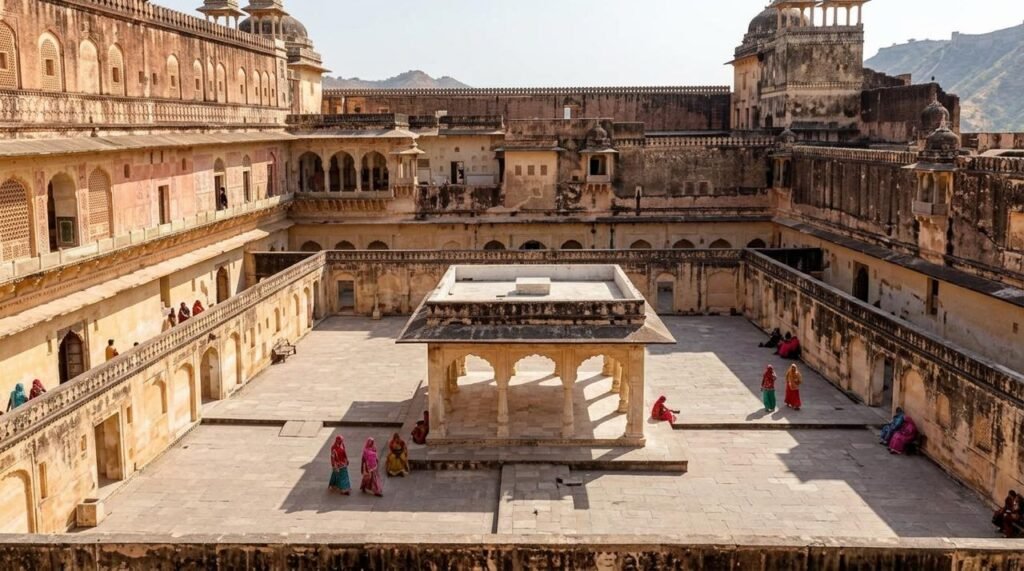
No two Rajasthan palaces did the women’s wing quite the same way, and the personality of each ruler shows up loudly in the stonework.
At Amber Fort, the Zanani Deorhi is a masterclass in palace politics. Each queen had her own apartment, and all of them opened onto a shared central courtyard.
Udaipur’s Zenana Mahal, inside the City Palace, was largely built between 1620 and 1628 under Maharana Karan Singh. The ground floor is classic Mewar; the upper floors, added later, pick up Mughal and British flourishes.
Over at Jodhpur’s Mehrangarh Fort, very nearly two-thirds of the fort was historically set aside for the women. The showpiece is Moti Mahal Chowk, wrapped in three wings of such intricate filigreed jharokhas you could stare for an hour and still miss half the detail.
At Bikaner’s Junagarh Fort, the zenana quarter was added by Maharaja Anup Singh, who ruled from 1669 to 1698. Nearby stands the older Phool Mahal, commissioned by Raja Rai Singh, its walls swimming with painted flower vases, rose-water sprinklers, and glass inlay that catches the light just right at dusk.
The Queens Who Actually Ran the Show
The old image of the cloistered Rajput queen pining prettily behind a jaali is completely false. Women inside the zenana commissioned temples, stepwells, and entire wings of palaces. They ran estates, managed their finances, and patronised musicians, painters, and poets. Some took over the kingdom outright as regents when a juvenile heir inherited the throne. Historian Rima Hooja has documented several Rajput queens who were sharp political operators whose advice, whispered through a curtain at the zenana’s entrance, influenced real policy.
And here is something worth noting – Maharaja Sawai Ram Singh II of Jaipur was an obsessive early photographer. In the 1860s, he turned his lens on the women of his own household. The glass plate negatives, now preserved in Jaipur’s City Palace archives, are among the earliest photographs of Indian noblewomen anywhere in existence. They show faces, personalities, wit, and moods.
Where the Zenana Still Breathes
The rituals that gave the zenana its element, Gangaur and Teej, have never quite left old Rajput homes. Clay idols of Gauri and Isar are still dressed every spring in century-old clothes and jewellery. The family and the village still gather in the zenana courtyard before sunset, pay their respects, and send the goddess off on her procession with drummers and fireworks.
This is the Rajasthan that still hums at Dera Mandawa, our family-run heritage haveli in Jaipur tucked just inside the old Pink City. Built in 1885 by Thakur Jait Singhji of Mandawa and still home to his great-grandson Thakur Durga Singhji and family, the suites blend Rajasthani jharokhas and arches with British-inspired doorframes, courtyards full of swings, and afternoons that are in absolutely no hurry. You can drape a saree, tie a safa, cook a proper Rajasthani meal with the family, and for a few hours, live at the pace the women of the zenana invented.
The institution may have gone. The artistry, the recipes, the humour, the calmly brilliant intelligence of that old world? Very much still here. Step inside the pol gate and listen.
