

There is a particular kind of magic that descends upon Rajasthan when the frenetic energy of the day begins to wane. The midday sun, often harsh and bleaching, softens into a golden, bruised light, and the shadows lengthen, revealing details that were previously lost in the glare.
For the discerning traveller, this is the golden hour in more ways than one. It is arguably the finest time to experience the state’s architectural marvels, far removed from the jostling elbows of tour bus queues. Nowhere is this more evident than when standing before the geometric abyss of the Chand Baori stepwell.
The Timeless Allure of Chand Baori Stepwell
In the village of Abhaneri, roughly ninety kilometres from the Pink City, lies a structure that defies simple description. Built over a thousand years ago by King Chanda of the Nikumbha Dynasty, the Chand Baori stepwell is one of the deepest and largest of its kind in India. It was originally conceived to conserve water in the parched landscape and serve as a cool community gathering place during the fierce summer heat.
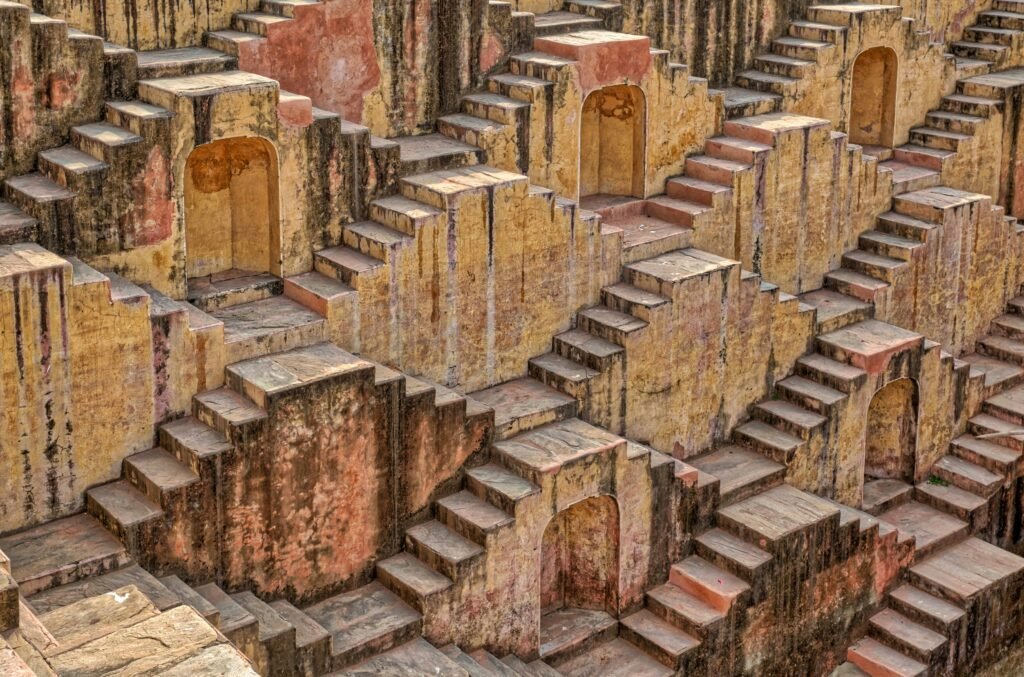
However, to call it a ‘well’ feels like a severe understatement. Yet calling it merely a well feels insufficient. The Chand Baori stepwell is an inverted pyramid of stone – 3,500 perfectly symmetrical steps descending thirteen storeys into the earth. Its geometric precision creates a visual rhythm unlike anything seen in the region’s grand forts in Rajasthan or even the famed Rajasthan palaces.
When you arrive during peak hours, the site can feel frantic. But if you time your visit for the late afternoon, as the bulk of the day-trippers are heading back to their coaches, the Chand Baori stepwell reclaims its ancient silence. This is the moment when the stone seems to breathe. The intricate dance of light and shadow across the diamond-shaped steps becomes more pronounced, creating a hypnotic, strangely calming visual rhythm.
A Masterclass in Ancient Engineering
As you stand at the rim of Chand Baori Stepwell looking down into the cool green waters at the base, you are looking at one of the most sophisticated Indian heritage sites in existence. The temperature at the bottom of the well is reportedly five to six degrees cooler than at the surface, a testament to the ingenuity of ancient architects.
Visiting the Chand Baori stepwell in the quiet of the late afternoon allows you to appreciate the details that others miss. You can trace the carvings on the pillars of the pavilion, where royals once rested, without being hurried along. You can marvel at the mathematical precision of the steps without a selfie stick obstructing your view. It is a moment of profound connection with the past, a reminder of a time when utility and beauty were not mutually exclusive concepts.
Beyond the Steps: The Temple of Joy
Adjacent to the Chand baori stands the Harshat Mata Temple, dedicated to the goddess of joy and happiness. Though ravaged by time and invaders, the temple ruins still possess a serene dignity. The detailed sculptures that remain speak of a rich artistic culture. Wandering through these ruins after viewing the Chand Baori stepwell presents a complete picture of Abhaneri’s historical significance.
For our guests at Dera Mandawa, this excursion provides a glimpse into rural Rajasthan that is usually obscured by the bustle of the main cities. The drive itself is a transition from the urban to the pastoral, passing mustard fields and camel carts, setting the stage for a slower pace of exploration.
The Art of the Day Trip
Curating places to visit near Jaipur requires balancing travel time and experience quality. Abhaneri fits this criterion perfectly. While there are many day trips from Jaipur, few propose the striking visual contrast of Chand Baori. The sheer scale of the excavation compared to the flat, arid landscape surrounding it is startling. For those interested in expanding their itinerary, the stepwell can be combined with a visit to the haunted ruins of Bhangarh Fort. However, we often find that the stepwell commands enough awe to stand alone as the day’s highlight.
Returning to the Pink City
After a day spent exploring these magnificent Indian heritage sites, the return to Jaipur feels like a homecoming. The dusty roads give way to the familiar gates of Dera Mandawa, where the courtyard proffers its own form of sanctuary.
There is a distinct pleasure in washing off the travel dust and settling into a planter’s chair with a cool drink, discussing the day’s sights. Our guests often tell us that the geometric rigour of the Chand Baori stepwell stays with them long after they have left. It is a vivid memory of order and depth that contrasts beautifully with the organic, living heritage of our heritage haveli in Jaipur.
Unlike the static monuments, Dera Mandawa is a place where history is lived. Yet seeing the stepwell reminds us of the enduring nature of Rajasthani architecture. It deepens one’s appreciation for the region’s legacy. When you look for places to visit near Jaipur, you are usually presented with crowded palaces and forts. The stepwell offers something different: introspection.
Leaving the Ancient World Behind
Rajasthan is a land of sensory overload, a riot of colour and noise. But it also holds pockets of profound stillness. The Chand Baori stepwell is one such pocket. To see it when the crowds have gone, when the sun dips low, and the pigeons settle into the crevices of the ancient stone, is to see the true face of the desert state. It is one of the most rewarding day trips from Jaipur for the traveller who seeks not just to see, but to feel. So, when you plan your itinerary, carve out space for Abhaneri. Let the crowds disperse. Let the silence settle. And let the ancient geometry of the stepwell reveal itself to you in its own time.
And when the day concludes, return to the calm of Dera Mandawa, one of the distinguished boutique hotels in Jaipur, where heritage continues not as monument, but as lived experience.
We look forward to welcoming you.
